Paper summary: Prometheus: Inducing Fine-grained Evaluation Capability in Language Models
Prometheus is an open 13B evaluator LLM trained on GPT-4-generated feedback that scores long-form answers against a user-provided rubric, approaching GPT-4's agreement with human raters.
Problem
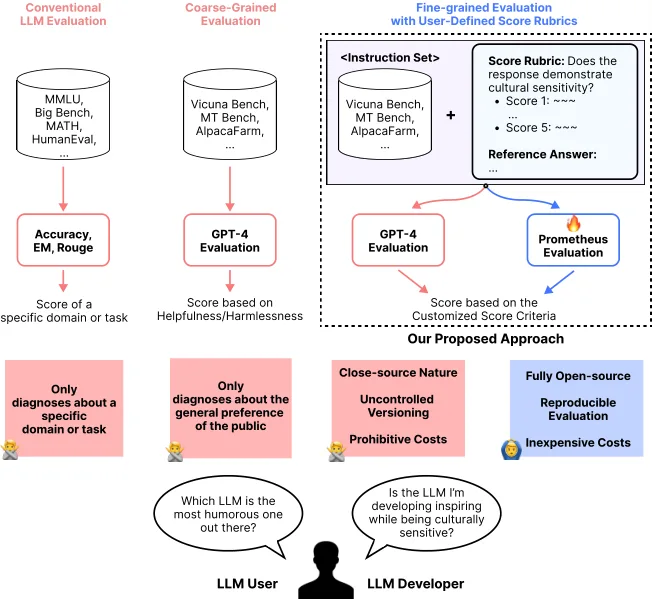
Using GPT-4 as a judge of long-form answers had become standard. For practitioners, though, a closed model is a problem: versions change silently, costs add up at scale, and custom criteria (“is this readable for a child?”) are hard to control.
Method
The authors built the Feedback Collection with GPT-4: about 1K fine-grained score rubrics, 20K instructions and 100K responses with written feedback. They trained Prometheus, a 13B open model, to take an instruction, a response, a reference answer and a rubric, and output written feedback plus a score.
Key results
As reported in the abstract:
- On 45 custom rubrics, Prometheus’s scores correlate with human evaluators at Pearson 0.897, on par with GPT-4 (0.882) and far above ChatGPT (0.392).
- Across 1,222 rubrics on four benchmarks, its correlation with GPT-4 follows similar trends.
Limitations
The evaluator is trained on GPT-4-generated feedback, so it inherits that teacher’s biases. It also relies on having a good reference answer and rubric, which the abstract makes a condition (“when the appropriate reference materials … are accompanied”).
Sources
- Prometheus: Inducing Fine-grained Evaluation Capability in Language Models (arXiv:2310.08491) — arXiv
- Hugging Face Daily Papers, 2023-10-12 — Hugging Face
This is a summary written from the linked public sources. Figures and numbers are as reported there.