Paper summary: ShareGPT4Video: Improving Video Understanding and Generation with Better Captions
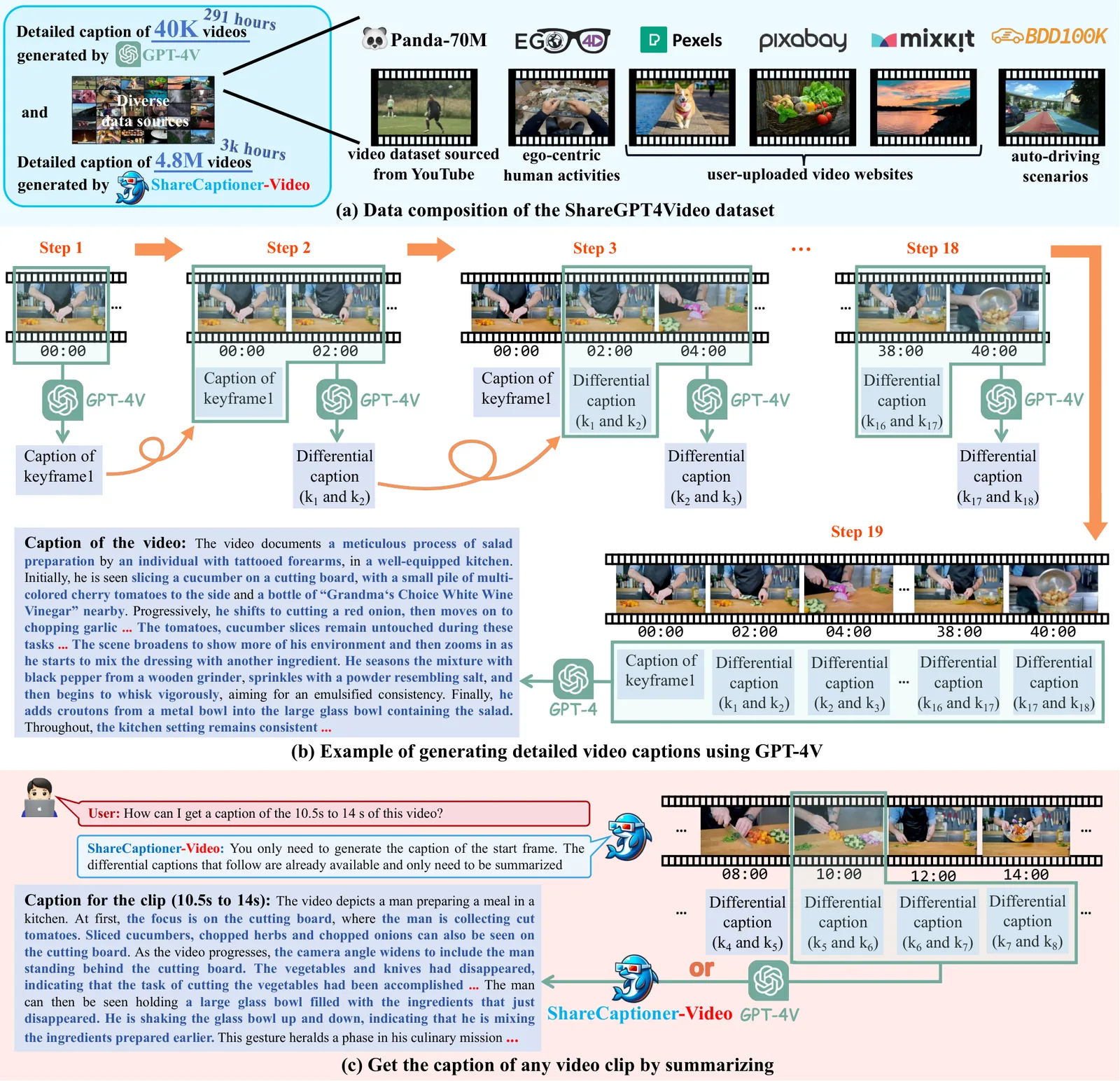
ShareGPT4Video builds dense, precise video captions (40K with GPT-4V, then 4.8M with its own captioner) to improve both video understanding models and text-to-video generation.
Problem
Both video-language models and text-to-video models depend on captions, and most video captions are short and vague. Human annotation doesn’t scale, and the authors found that asking GPT-4V naively (several frames at once, or frames stitched together) gave less detailed and sometimes temporally confused captions.
Method
The series has three parts:
- ShareGPT4Video: 40K dense captions of videos of various lengths and sources, made with GPT-4V through a carefully designed filtering and annotation strategy. The strategy targets precise changes between frames, detailed content within frames, and scaling to long videos.
- ShareCaptioner-Video: a captioning model trained on that data, used to caption 4.8M high-quality, aesthetic videos.
- ShareGPT4Video-8B: a video LVLM trained with the captions.
Key results
The abstract reports that ShareGPT4Video-8B reaches state-of-the-art performance on three video benchmarks.
Limitations
From the paper:
- the caption pipeline can’t use audio, because GPT-4V doesn’t take audio input
- the large set of generated captions wasn’t manually checked for social bias
- the source videos may contain human faces, so users must follow the original videos’ licences
Sources
- ShareGPT4Video: Improving Video Understanding and Generation with Better Captions (arXiv:2406.04325) — arXiv
- Hugging Face Daily Papers, 2024-06-07 — Hugging Face
- ShareGPT4Video: Improving Video Understanding and Generation with Better Captions (arXiv HTML full text) — arXiv
This is a summary written from the linked public sources. Figures and numbers are as reported there.