Paper summary: The AI Scientist: Towards Fully Automated Open-Ended Scientific Discovery
The AI Scientist chains LLM steps that generate research ideas, write and run experiment code, write a full paper and review it with an automated reviewer, as a framework for fully automated research.
Problem
Frontier models already help scientists with parts of research: brainstorming, code, prediction. But they cover only a small part of the scientific process. Could an LLM-driven system do the whole loop on its own?
Method
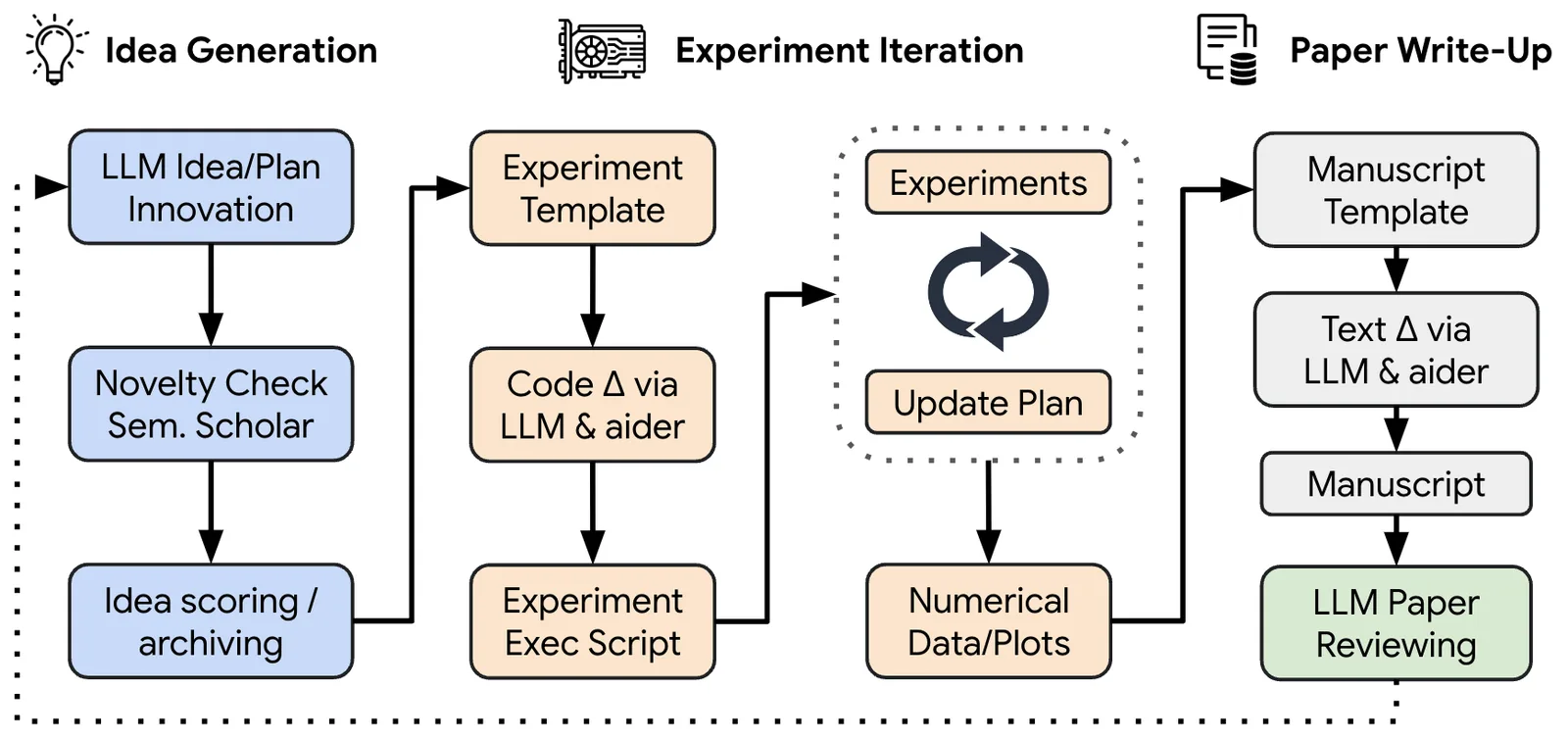
The AI Scientist is an end-to-end pipeline (the paper’s Figure 1):
- generate research ideas and assess their novelty
- write code and run experiments
- visualise the results
- write a full scientific paper
- run a simulated review with an LLM reviewer
In principle the loop can repeat, building on earlier ideas in an open-ended way.
Key results
The authors demonstrate the framework on several machine-learning subfields and present it as the first comprehensive framework for fully automatic scientific discovery with frontier LLMs.
Limitations
The paper has an extensive limitations and ethics section. On the automated reviewer alone, it notes:
- the ICLR 2022 data used to validate it may appear in the base models’ pre-training data, though preliminary checks suggest the reviews weren’t memorised
- rejected papers in the dataset used the original submission files, so the comparison isn’t perfectly like-for-like
The authors also discuss broader ethical considerations of automated research.
Sources
- The AI Scientist: Towards Fully Automated Open-Ended Scientific Discovery (arXiv:2408.06292) — arXiv
- Hugging Face Daily Papers, 2024-08-13 — Hugging Face
- The AI Scientist: Towards Fully Automated Open-Ended Scientific Discovery (arXiv HTML full text) — arXiv
- Code repository (linked in the paper) — GitHub
This is a summary written from the linked public sources. Figures and numbers are as reported there.