Paper summary: SFT Memorizes, RL Generalizes: A Comparative Study of Foundation Model Post-training
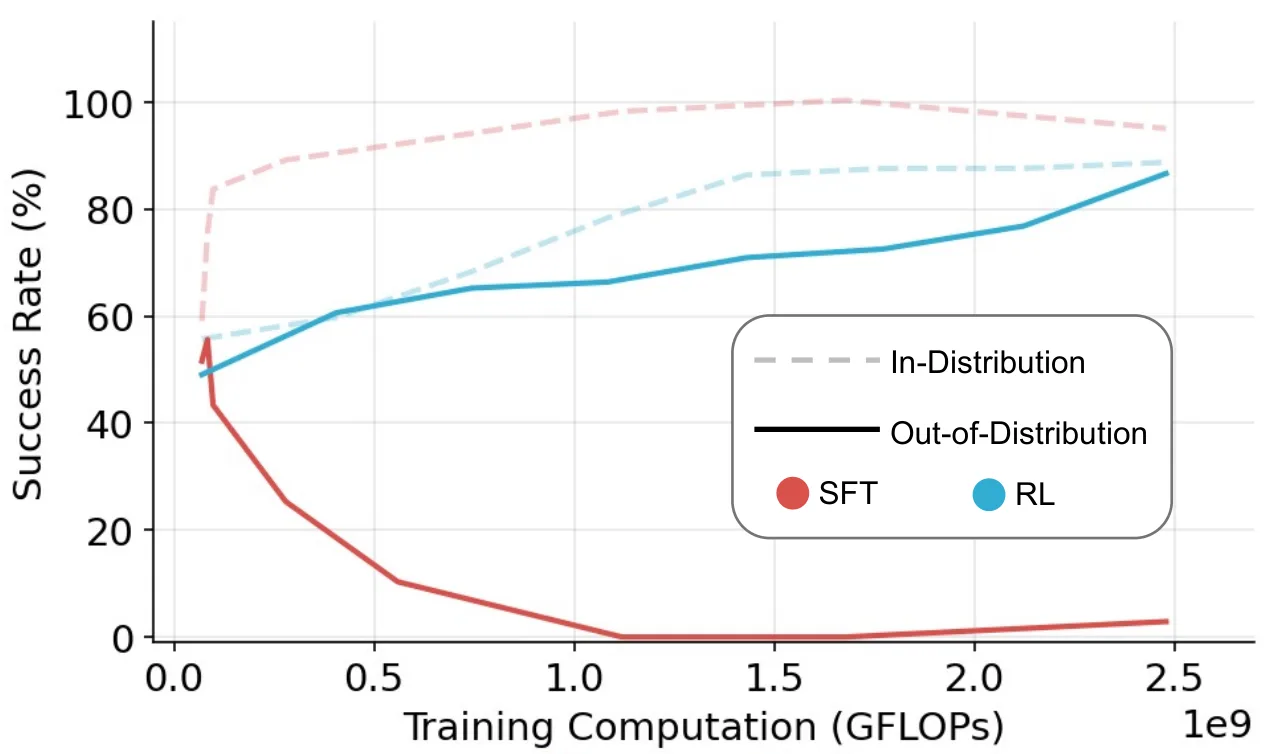
On a card-arithmetic game and a real-world navigation task, models post-trained with RL generalise to unseen rule and visual variants, while SFT tends to memorise the training data.
Problem
Supervised fine-tuning (SFT) and reinforcement learning (RL) are both standard post-training steps, but it’s unclear how each affects generalisation versus memorisation.
Method
Two test beds with controlled variations:
- GeneralPoints: an arithmetic reasoning card game, with variants in the rules (text) and in how the cards look (visual)
- V-IRL: a real-world navigation environment
Models trained with SFT or RL are evaluated on unseen variants, out of distribution.
Key results
From the abstract and Figure 1:
- RL, especially with an outcome-based reward, generalises across both rule-based textual and visual variants
- SFT tends to memorise training data and struggles out of distribution
- RL also improves the model’s underlying visual recognition
- SFT still helps, by stabilising the output format so that later RL can work
Limitations
From the paper: two challenges were unresolved. One is that SFT failed to reach in-distribution performance comparable to RL on the visual-language GeneralPoints variant, even after extra hyperparameter tuning to rule out variance.
Sources
- SFT Memorizes, RL Generalizes: A Comparative Study of Foundation Model Post-training (arXiv:2501.17161) — arXiv
- Hugging Face Daily Papers, 2025-01-29 — Hugging Face
- SFT Memorizes, RL Generalizes: A Comparative Study of Foundation Model Post-training (arXiv HTML full text) — arXiv
This is a summary written from the linked public sources. Figures and numbers are as reported there.