Paper summary: Feature-Level Insights into Artificial Text Detection with Sparse Autoencoders
Using sparse-autoencoder features from Gemma-2-2B's residual stream to detect and explain AI-generated text, revealing a distinct LLM writing style, especially in information-dense domains.
Problem
Detecting AI-generated text is increasingly important, but according to the abstract, no single algorithm works consistently across unseen kinds of text or generalises to new LLMs.
Method
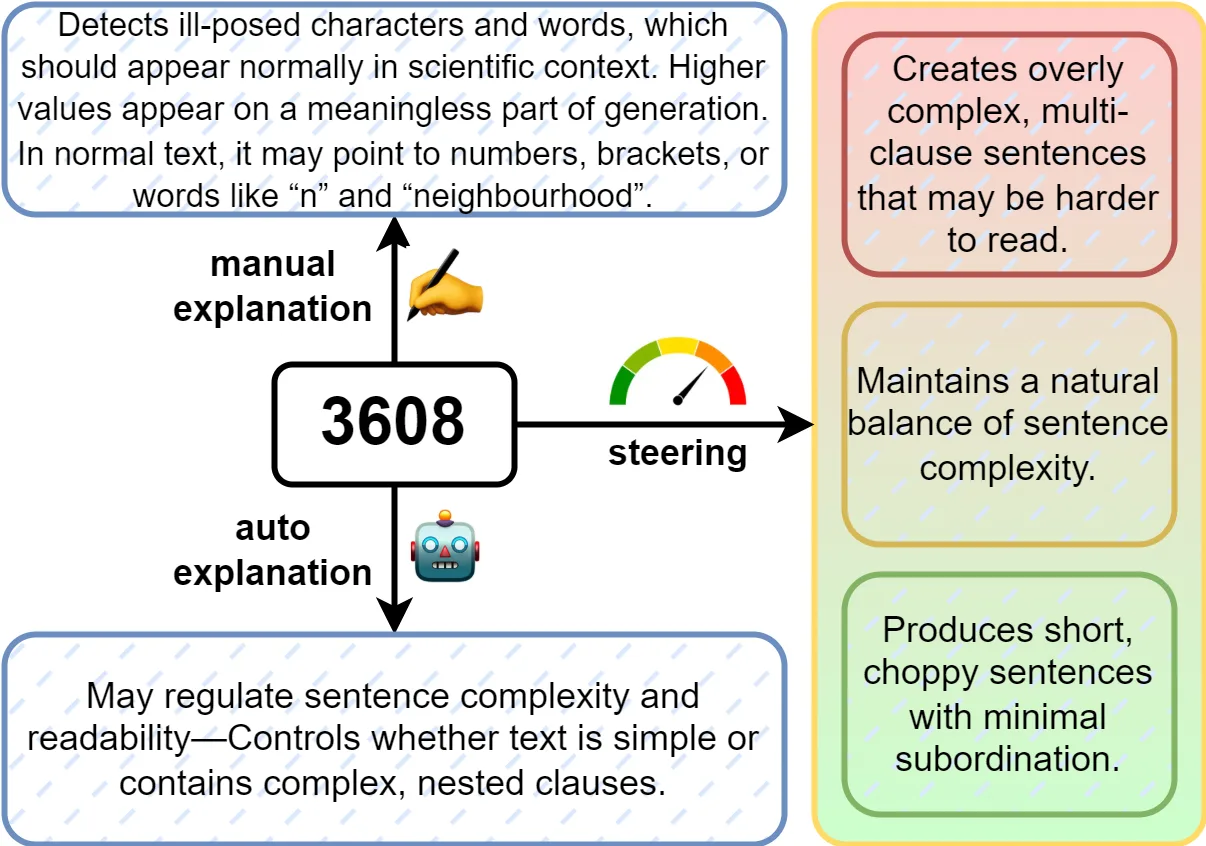
The authors extract features with sparse autoencoders (SAEs) from the residual stream of Gemma-2-2B, then find features that are both interpretable and useful for detection. They analyse them with domain- and model-specific statistics, a steering approach, and manual or LLM-based interpretation. Figure 1 shows interpretations of one of the most “universal” detection features.
Key results
The paper reports interpretable and efficient features, and finds that modern LLMs have a distinct writing style, especially in information-dense domains.
Limitations
From the paper:
- new LLMs appear constantly, so future performance is hard to predict
- new attack strategies keep appearing, and only some are covered
- not all SAE features have a clear meaning
- only one SAE on one model (Gemma 2-2B) was used
#llm#interpretability#detection
Sources
- Feature-Level Insights into Artificial Text Detection with Sparse Autoencoders (arXiv:2503.03601) — arXiv
- Hugging Face Daily Papers, 2025-03-11 — Hugging Face
- Feature-Level Insights into Artificial Text Detection with Sparse Autoencoders (arXiv HTML full text) — arXiv
This is a summary written from the linked public sources. Figures and numbers are as reported there.