Paper summary: Absolute Zero: Reinforced Self-play Reasoning with Zero Data
Absolute Zero trains a model to propose its own coding and maths-style tasks and then solve them, with a code executor checking both, so reasoning improves through self-play with no external training data.
Problem
RL with verifiable rewards (“zero” settings) avoids labelling reasoning steps, but still needs curated question–answer sets. The authors argue that relying on human-made examples won’t scale, and might limit a future system that’s better than humans.
Method
Absolute Zero: a single model learns to propose tasks that maximise its own learning progress, and to solve them. The Absolute Zero Reasoner (AZR) uses a code executor to:
- validate that a proposed code-reasoning task is well-formed
- verify the solver’s answers
The executor is the one source of verifiable reward, which keeps the open-ended curriculum grounded.
Key results
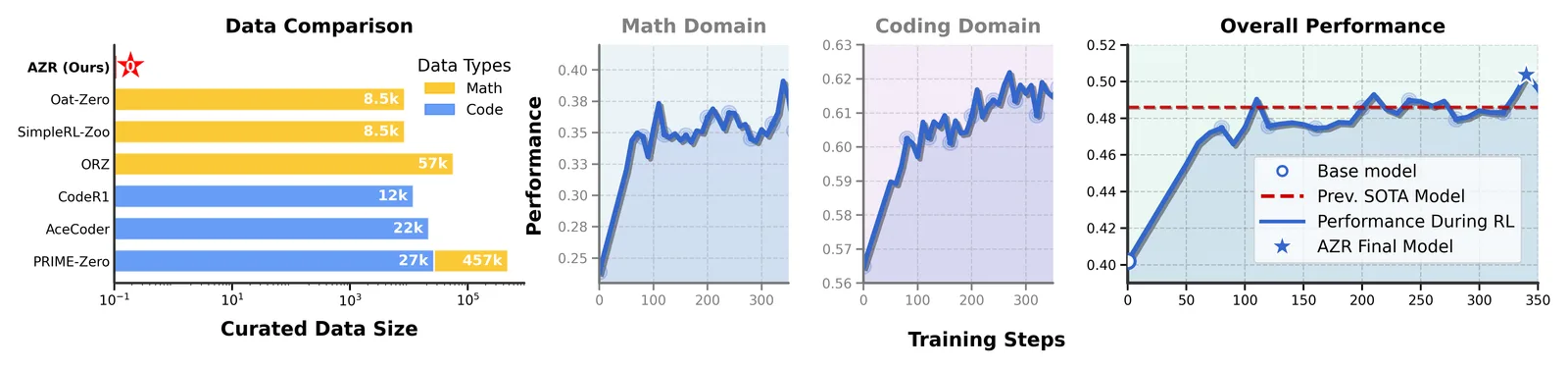
From the abstract: trained entirely without external data, AZR reaches overall state-of-the-art performance on coding and mathematical reasoning, beating zero-setting models that use tens of thousands of human-curated examples. It works across model scales and model classes. Figure 1 summarises the results.
Limitations
There’s no dedicated limitations section in the extracted text. The approach relies on tasks that a code executor can verify.
Sources
- Absolute Zero: Reinforced Self-play Reasoning with Zero Data (arXiv:2505.03335) — arXiv
- Hugging Face Daily Papers, 2025-05-07 — Hugging Face
- Absolute Zero: Reinforced Self-play Reasoning with Zero Data (arXiv HTML full text) — arXiv
- Code repository (linked in the paper) — GitHub
This is a summary written from the linked public sources. Figures and numbers are as reported there.