Paper summary: Drag-and-Drop LLMs: Zero-Shot Prompt-to-Weights
Drag-and-Drop LLMs train a generator that maps a few unlabelled task prompts straight to LoRA weights, specialising an LLM for a new task in seconds without any gradient-based fine-tuning on it.
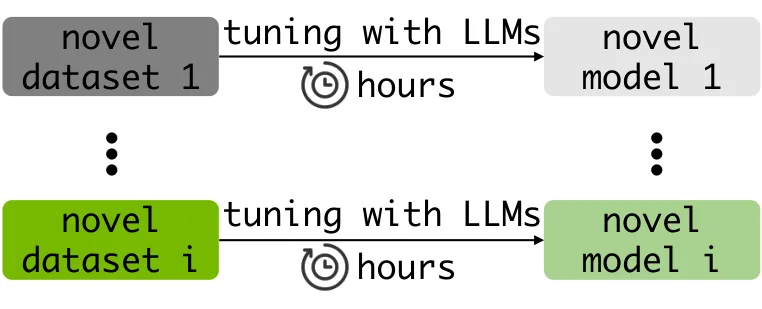
Problem
LoRA (my February study notes) makes fine-tuning cheaper, but every new dataset still needs its own optimisation run.
Method
Drag-and-Drop LLMs (DnD) learn a prompt-conditioned parameter generator:
- a lightweight text encoder turns a batch of unlabelled task prompts into condition embeddings
- a cascaded hyper-convolutional decoder turns those into the full set of LoRA matrices
The generator is trained on many (prompts, trained-LoRA-checkpoint) pairs. For a new task, it produces task-specific weights in seconds, with no training on that task.
Key results
From the abstract:
- up to 12,000× lower overhead than full fine-tuning
- average gains up to 30% over the strongest training LoRAs on unseen common-sense, maths, coding and multimodal benchmarks
- robust cross-domain generalisation without seeing target data or labels
Limitations
There’s no dedicated limitations section in the extracted text. The generator must first be trained on a diverse collection of existing LoRA checkpoints.
Sources
- Drag-and-Drop LLMs: Zero-Shot Prompt-to-Weights (arXiv:2506.16406) — arXiv
- Hugging Face Daily Papers, 2025-06-23 — Hugging Face
- Drag-and-Drop LLMs: Zero-Shot Prompt-to-Weights (arXiv HTML full text) — arXiv
This is a summary written from the linked public sources. Figures and numbers are as reported there.