Paper summary: MemOS: A Memory OS for AI System
MemOS proposes a memory operating system for LLMs that manages plaintext, activation-based and parameter-level memory as one schedulable resource, built around "MemCube" units with provenance and versioning.
Problem
LLMs have no well-defined memory management. Knowledge sits in fixed parameters or short-lived context. That limits long-context reasoning, continual personalisation and knowledge consistency. According to the abstract, RAG helps, but it’s a stateless workaround without lifecycle control.
Method
MemOS is a memory operating system that treats memory as a manageable system resource. It unifies the representation, scheduling and evolution of three kinds of memory:
- plaintext memory (retrievable text)
- activation-based memory (e.g. cached states)
- parameter-level memory (knowledge in weights)
The basic unit is the MemCube: memory content plus metadata such as provenance and versioning. MemCubes can be composed, migrated and fused over time, moving knowledge between memory types.
Key results
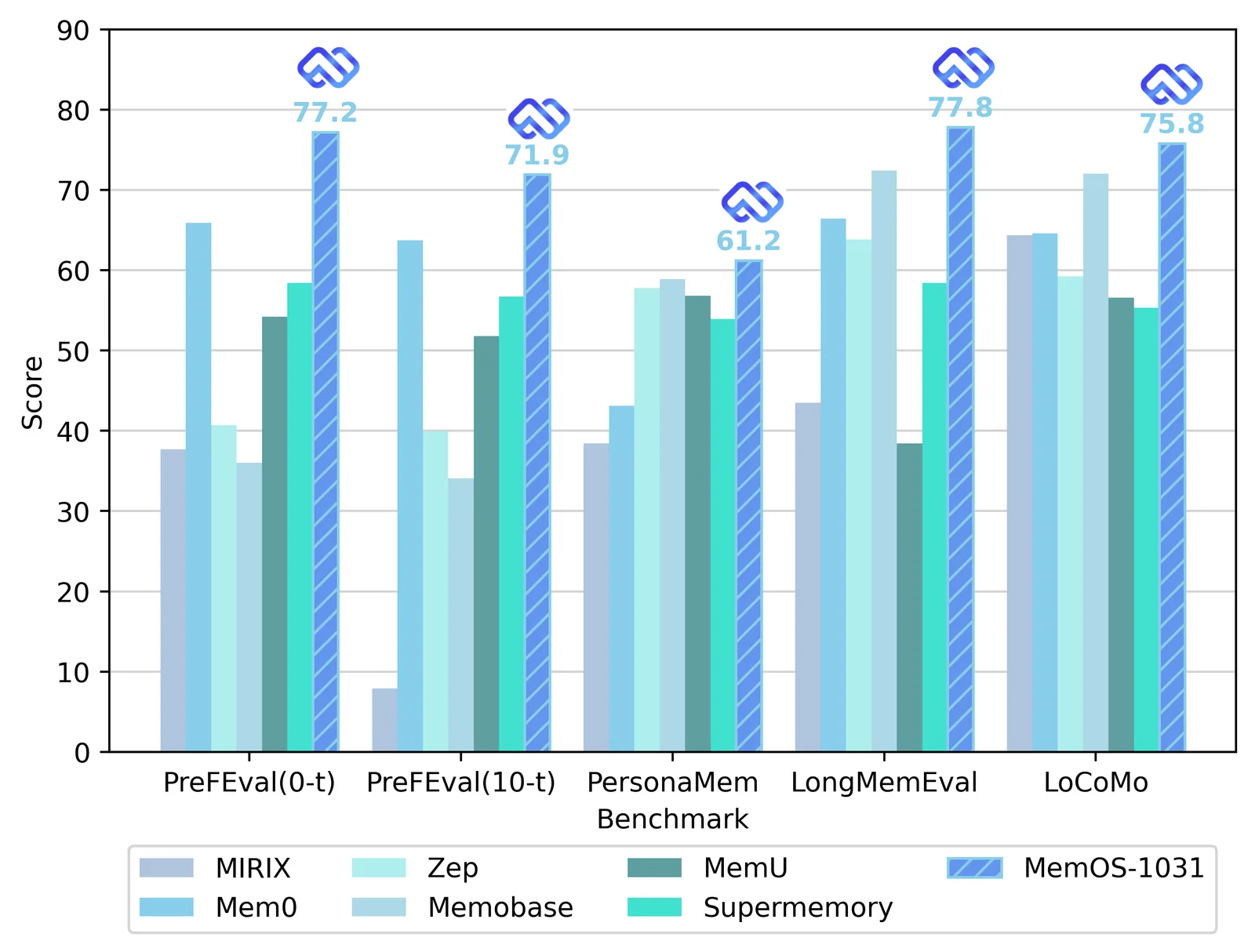
Figure 1 summarises the authors’ evaluation, showing MemOS achieving state-of-the-art results across their memory benchmarks. The broader claim is a framework for controllability, plasticity and evolvability, as a basis for continual learning and personalisation.
Limitations
There’s no dedicated limitations section in the extracted text. Much of the paper is an architectural proposal, and the evaluation uses the authors’ chosen benchmarks.
Sources
- MemOS: A Memory OS for AI System (arXiv:2507.03724) — arXiv
- Hugging Face Daily Papers, 2025-07-08 — Hugging Face
- MemOS: A Memory OS for AI System (arXiv HTML full text) — arXiv
- Code repository (linked in the paper) — GitHub
This is a summary written from the linked public sources. Figures and numbers are as reported there.