Paper summary: InternVL3.5: Advancing Open-Source Multimodal Models in Versatility, Reasoning, and Efficiency
InternVL3.5 adds Cascade RL (offline then online RL), a Visual Resolution Router and decoupled vision/language deployment, reporting up to +16% reasoning and 4.05× faster inference than InternVL3.
Problem
The InternVL series (InternVL 2.5 and 3 were summarised here in Dec 2024 and Apr 2025) keeps pushing open multimodal models. This version targets reasoning and inference efficiency.
Method
- Cascade RL: a two-stage, coarse-to-fine process. Offline RL first, for stable convergence, then online RL for refined alignment.
- Visual Resolution Router (ViR): dynamically adjusts the resolution of visual tokens without hurting performance.
- Decoupled Vision-Language Deployment (DvD): put the vision encoder and the language model on different GPUs to balance the load.
Key results
From the abstract:
- up to +16.0% overall reasoning performance and 4.05× inference speed-up compared with InternVL3
- new abilities such as GUI interaction and embodied agency
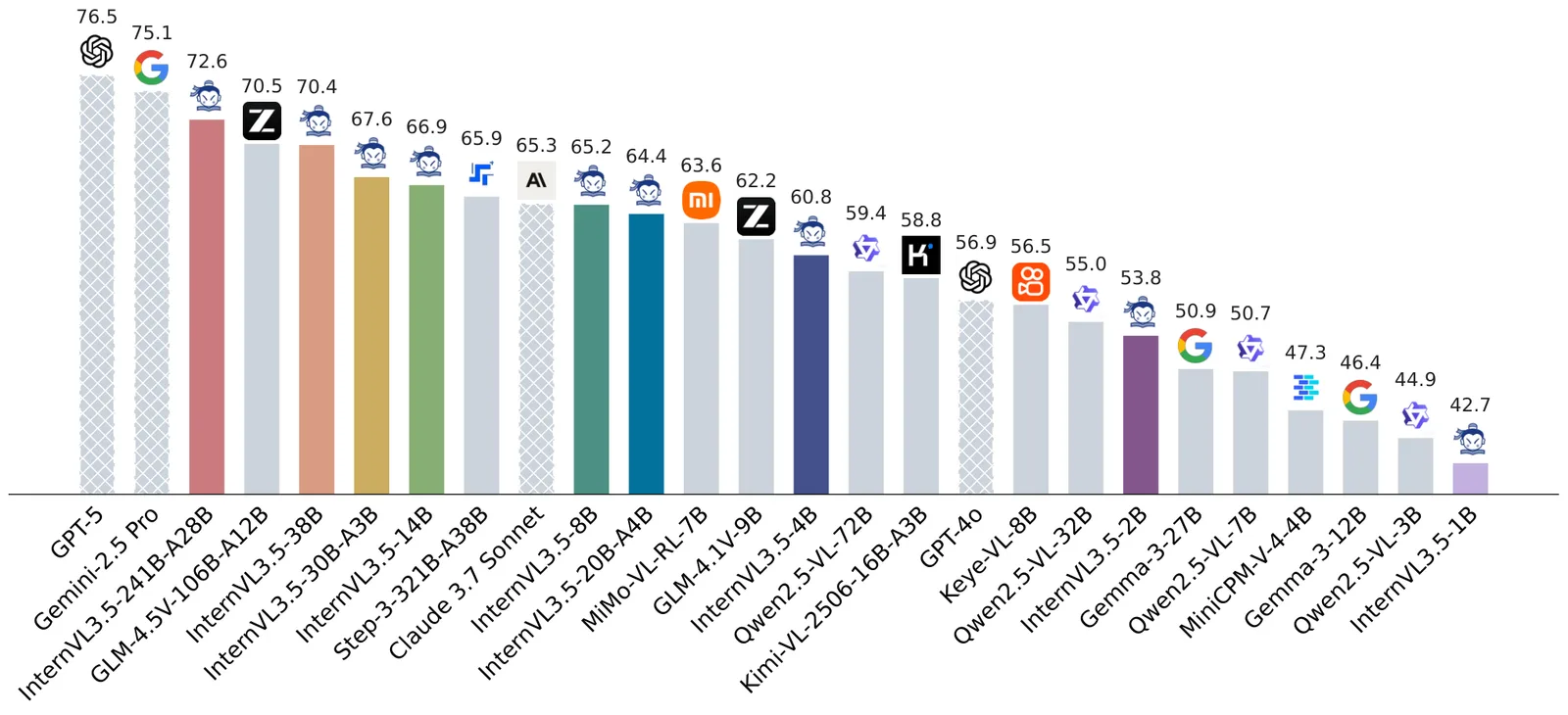
- the largest model, InternVL3.5-241B-A28B, is state of the art among open MLLMs on general multimodal, reasoning, text and agentic tasks, narrowing the gap to commercial models like GPT-5 (Figure 1)
Limitations
There’s no dedicated limitations section in the extracted text. Comparisons with commercial models are the authors’ own.
#multimodal#reasoning#efficiency
Sources
- InternVL3.5: Advancing Open-Source Multimodal Models in Versatility, Reasoning, and Efficiency (arXiv:2508.18265) — arXiv
- Hugging Face Daily Papers, 2025-08-26 — Hugging Face
- InternVL3.5: Advancing Open-Source Multimodal Models in Versatility, Reasoning, and Efficiency (arXiv HTML full text) — arXiv
This is a summary written from the linked public sources. Figures and numbers are as reported there.