Paper summary: A Theoretical Study on Bridging Internal Probability and Self-Consistency for LLM Reasoning
A theoretical framework for sampling-based test-time scaling shows self-consistency has high estimation error and perplexity has high modelling error; the hybrid RPC method matches self-consistency with half the samples.
Problem
Sampling many reasoning paths and picking an answer (self-consistency, or choosing by model probability) works in practice, but the theory behind it was thin.
Method
The authors build a theoretical framework that treats these methods as confidence estimation, and analyse two paradigms:
- self-consistency (majority vote): high estimation error
- perplexity (model probability): substantial modelling error, and its estimation error can converge badly
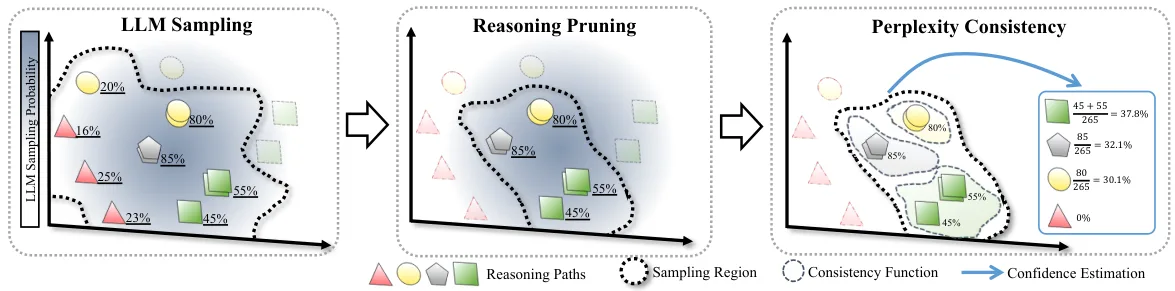
Their method RPC has two parts (Figure 1):
- Perplexity Consistency: combines the two, improving the convergence of estimation error from linear to exponential while keeping model error low
- Reasoning Pruning: removes low-probability reasoning paths to prevent degradation
Key results
From the abstract: across seven benchmarks, RPC matches self-consistency’s reasoning performance while improving confidence reliability and cutting sampling cost by 50%.
Limitations
From the paper: only two typical methods (plus RPC) are analysed in depth, and as a post-hoc selection method its gains are moderate compared with approaches that involve training.
#llm#reasoning#test-time-compute
Sources
- A Theoretical Study on Bridging Internal Probability and Self-Consistency for LLM Reasoning (arXiv:2510.15444) — arXiv
- Hugging Face Daily Papers, 2025-10-20 — Hugging Face
- A Theoretical Study on Bridging Internal Probability and Self-Consistency for LLM Reasoning (arXiv HTML full text) — arXiv
This is a summary written from the linked public sources. Figures and numbers are as reported there.