Transformers · Positional encoding
Why attention needs position information, the sinusoidal encoding from the original paper, learned position embeddings, and the relative-position idea behind RoPE.
Self-attention is permutation-equivariant. If you shuffle the input tokens, the outputs shuffle the same way, so the model can’t tell “dog bites man” from “man bites dog”. Position has to be added.
The original paper adds a fixed sinusoidal encoding to the embeddings:
Each dimension pair is a wave with a different frequency, so every position gets a unique pattern, and nearby positions get similar ones. Alternatives:
- learned position embeddings (BERT, GPT-2)
- relative methods such as RoPE (Su et al., 2021), which rotates queries and keys so their dot product depends on the distance between positions; many recent LLMs use it
I checked both claims: the permutation behaviour, and that sinusoidal encodings of nearby positions are more similar.
import os, math, torch
import matplotlib.pyplot as plt

def sinusoidal(n, d):
    pos = torch.arange(n).unsqueeze(1)
    div = torch.exp(torch.arange(0, d, 2) * (-math.log(10000.0) / d))
    pe = torch.zeros(n, d)
    pe[:, 0::2], pe[:, 1::2] = torch.sin(pos * div), torch.cos(pos * div)
    return pe

torch.manual_seed(0)
attn = torch.nn.MultiheadAttention(16, 2, batch_first=True)
x = torch.randn(1, 5, 16)
perm = torch.tensor([3, 0, 4, 1, 2])
out, _ = attn(x, x, x)
out_p, _ = attn(x[:, perm], x[:, perm], x[:, perm])
print("no positions -> output just shuffles:", torch.allclose(out[:, perm], out_p, atol=1e-6))

pe = sinusoidal(100, 64)
xp = x + pe[:5, :16]
out2, _ = attn(xp, xp, xp)
xpp = x[:, perm] + pe[:5, :16]
out2_p, _ = attn(xpp, xpp, xpp)
print("with positions -> no longer just shuffled:", not torch.allclose(out2[:, perm], out2_p, atol=1e-4))

cos = torch.nn.functional.cosine_similarity
print("similarity of pos 10 with pos 11, 20, 60:", [round(cos(pe[10], pe[j], dim=0).item(), 3) for j in (11, 20, 60)])

fig, ax = plt.subplots(figsize=(8, 3.2), dpi=150)
im = ax.imshow(pe.T, aspect="auto", cmap="RdBu")
ax.set_xlabel("position"); ax.set_ylabel("dimension"); ax.set_title("Sinusoidal positional encoding (100 positions, d=64)")
fig.colorbar(im, ax=ax); fig.tight_layout(); fig.savefig(os.environ["SNIPPET_FIG"])
Output:
no positions -> output just shuffles: True
with positions -> no longer just shuffled: True
similarity of pos 10 with pos 11, 20, 60: [0.966, 0.658, 0.49]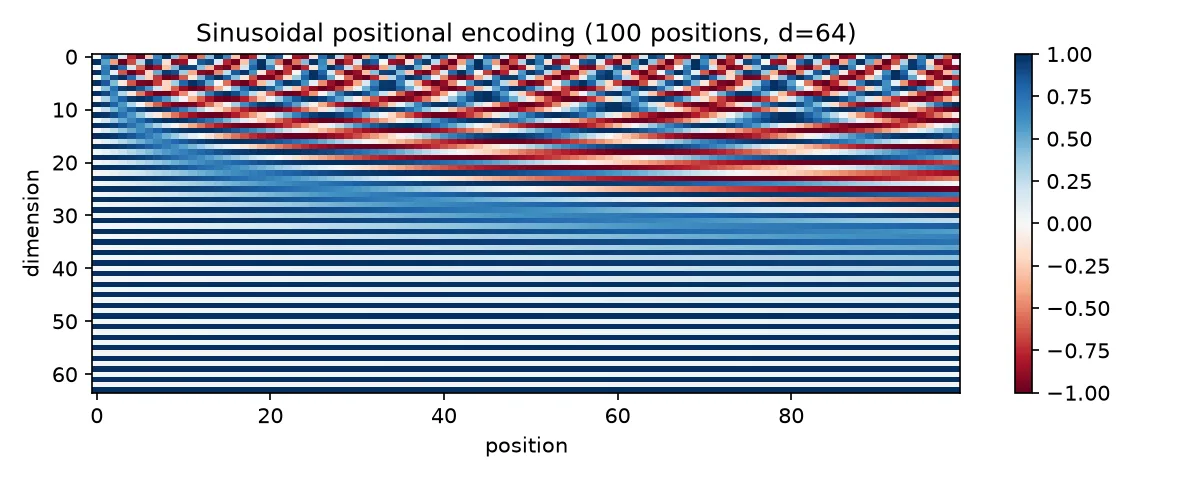
#transformers#positional-encoding