Paper summary: Thinking with Video: Video Generation as a Promising Multimodal Reasoning Paradigm
"Thinking with Video" uses a video generation model (Sora-2) as a reasoner, drawing its solution as video frames; on a new benchmark it rivals strong VLMs on visual puzzles and reaches 92% on MATH.
Problem
“Thinking with text” (chain-of-thought) and “thinking with images” both help models reason, but according to the abstract, images capture only single moments, and text and vision stay separate modalities.
Method
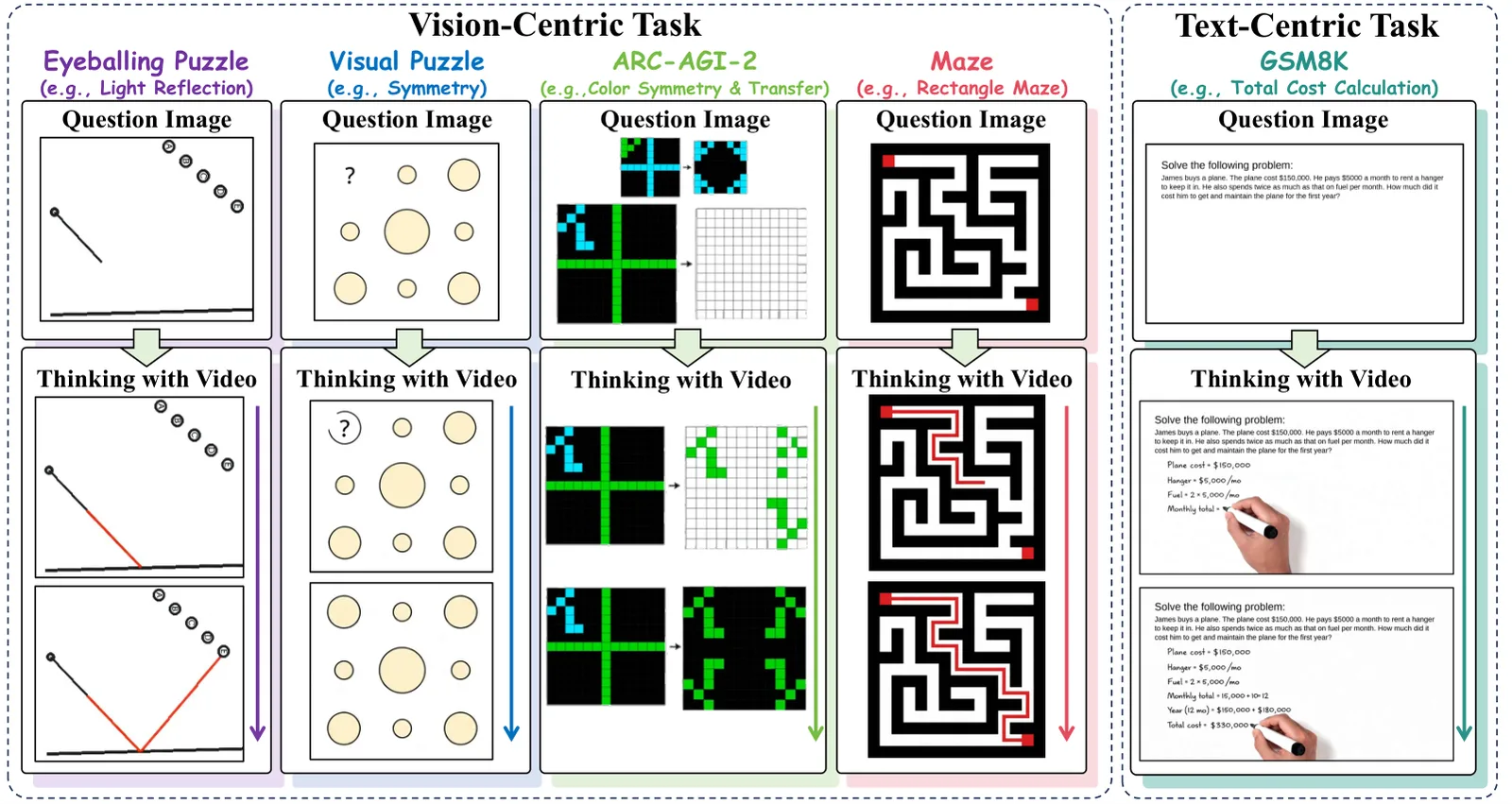
The authors propose “Thinking with Video”: use a video generation model such as Sora-2 as the reasoner, with video frames as a unified medium for working through a problem. They build VideoThinkBench, with vision-centric tasks (like eyeballing puzzles) and text-centric tasks (like GSM8K and MMMU). Figure 1 shows example solutions.
Key results
From the abstract:
- vision-centric tasks: comparable to state-of-the-art VLMs, and 10% above GPT-5 on eyeballing puzzles
- text-centric tasks: 92% on MATH and 69.2% on MMMU
- self-consistency and in-context learning improve Sora-2’s performance further
Limitations
From the paper: evaluation mainly covers Sora-2 among video models, and since Sora-2 isn’t open-source, its internal mechanisms can’t be analysed. More (especially open) video models are planned.
Sources
- Thinking with Video: Video Generation as a Promising Multimodal Reasoning Paradigm (arXiv:2511.04570) — arXiv
- Hugging Face Daily Papers, 2025-11-07 — Hugging Face
- Thinking with Video: Video Generation as a Promising Multimodal Reasoning Paradigm (arXiv HTML full text) — arXiv
- Code repository (linked in the paper) — GitHub
This is a summary written from the linked public sources. Figures and numbers are as reported there.