Paper summary: Kandinsky 5.0: A Family of Foundation Models for Image and Video Generation
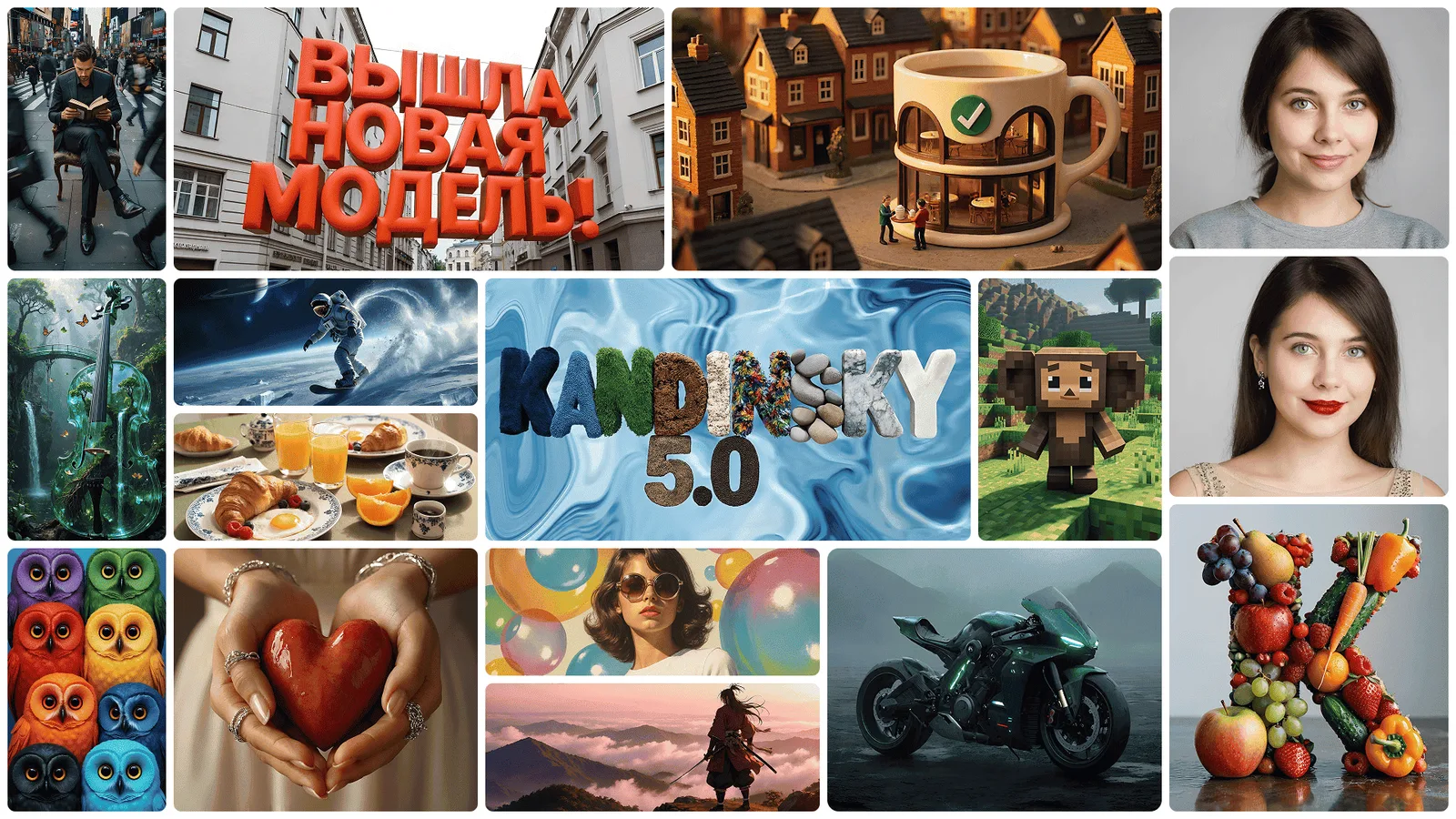
Kandinsky 5.0 is an open family of image and 10-second video generation models (6B Image Lite, 2B Video Lite, 19B Video Pro), with the full data-curation and multi-stage training pipeline described.
Problem
Kandinsky (the 2023 version is summarised on this blog) moves from images to video, aiming for high quality, high speed and an open release.
Method
Three line-ups:
- Image Lite: 6B-parameter image models
- Video Lite: fast, lightweight 2B text-to-video and image-to-video models
- Video Pro: 19B models for top video quality
The report covers the whole data-curation lifecycle (collection, processing, filtering, clustering) and a multi-stage pipeline of extensive pre-training, then quality-focused fine-tuning and RL-based post-training, plus architectural, training and inference optimisations. Code and checkpoints are released.
Key results
From the abstract: high generation speed and state-of-the-art performance across tasks, as shown by human evaluation.
Limitations
From the paper: in side-by-side comparisons, text–visual alignment lags slightly behind some competitors, which the authors attribute mainly to the 256-token context of the Qwen2.5-VL 7B text encoder. They also list temporal consistency for complex dynamics as an area to improve.
Sources
- Kandinsky 5.0: A Family of Foundation Models for Image and Video Generation (arXiv:2511.14993) — arXiv
- Hugging Face Daily Papers, 2025-11-20 — Hugging Face
- Kandinsky 5.0: A Family of Foundation Models for Image and Video Generation (arXiv HTML full text) — arXiv
- Code repository (linked in the paper) — GitHub
This is a summary written from the linked public sources. Figures and numbers are as reported there.