Paper summary: General Agentic Memory Via Deep Research
General Agentic Memory keeps a light memory plus the full history in a page-store, then uses a "researcher" agent to build the right context at request time, like just-in-time compilation for memory.
Problem
Most agent memory is static: it’s summarised ahead of time so it’s ready to use. According to the abstract, this inevitably loses information that turns out to matter later.
Method
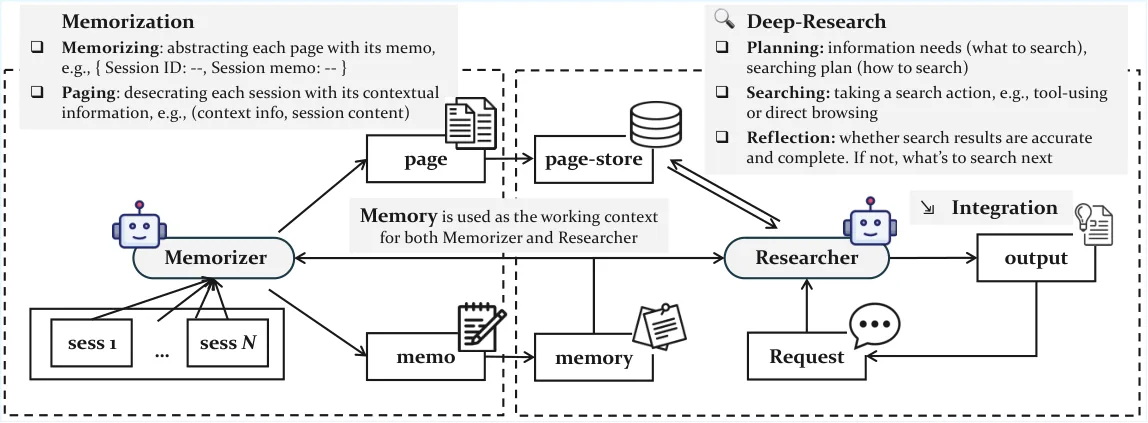
General agentic memory (GAM) follows a “just-in-time compilation” principle: keep simple but useful memory offline, and build an optimised context at runtime for each request (Figure 1).
- Memorizer: writes a lightweight memory that highlights key history, while keeping the complete history in a universal page-store.
- Researcher: when a request comes in, it searches the page-store, guided by the light memory, and integrates what it finds, much like a deep-research agent.
The design benefits from frontier LLMs’ agentic abilities and test-time scaling, and can be optimised end to end with RL.
Key results
The abstract reports substantial improvements over existing memory systems in memory-grounded task completion.
Limitations
There’s no dedicated limitations section in the extracted text. Runtime research costs more per request than looking up a pre-built summary.
Sources
- General Agentic Memory Via Deep Research (arXiv:2511.18423) — arXiv
- Hugging Face Daily Papers, 2025-11-25 — Hugging Face
- General Agentic Memory Via Deep Research (arXiv HTML full text) — arXiv
- Code repository (linked in the paper) — GitHub
This is a summary written from the linked public sources. Figures and numbers are as reported there.