Paper summary: DataFlow: An LLM-Driven Framework for Unified Data Preparation and Workflow Automation in the Era of Data-Centric AI
DataFlow is an LLM-driven framework for building data-preparation pipelines from about 200 reusable operators with a PyTorch-style API, plus an agent that turns plain-language specs into pipelines.
Problem
LLM data preparation is mostly ad-hoc scripts and loosely specified workflows, hard to reproduce and with little support for model-in-the-loop generation.
Method
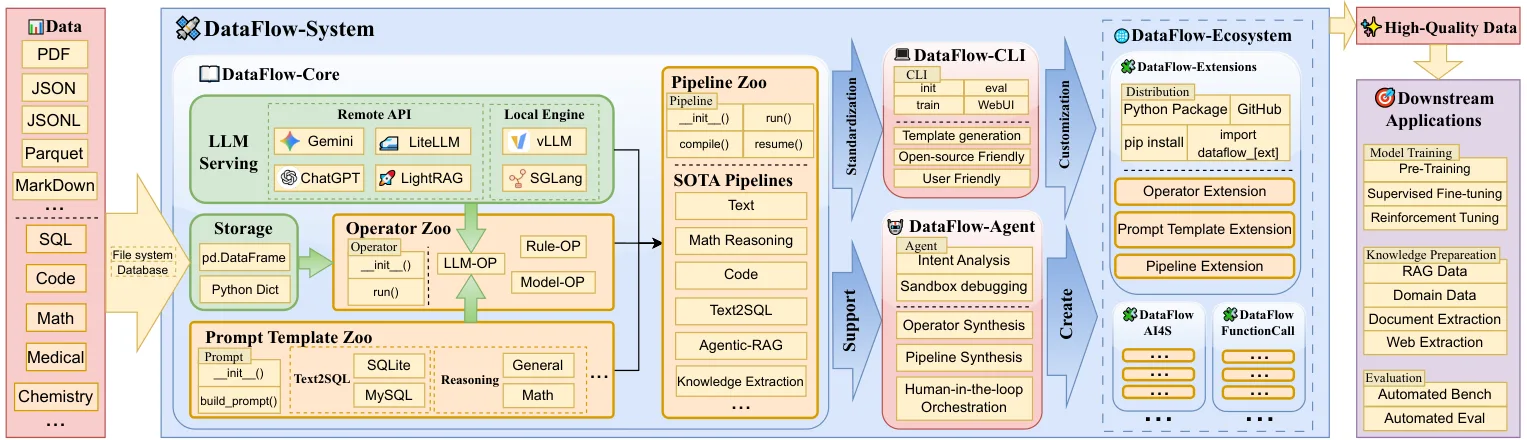
DataFlow provides (Figure 1):
- system-level abstractions for modular, reusable, composable data transformations
- a PyTorch-style API for building debuggable, optimisable pipelines
- nearly 200 operators and six general pipelines: text, maths reasoning, code, Text-to-SQL, agentic RAG and large-scale knowledge extraction
- DataFlow-Agent, which translates natural-language specs into executable pipelines through operator synthesis, planning and iterative verification
Key results
From the abstract, across six use cases:
- up to +3% execution accuracy in Text-to-SQL over SynSQL
- +7% average on code benchmarks
- 1–3 point gains on MATH, GSM8K and AIME
- a unified 10K-sample dataset lets base models surpass counterparts trained on 1M Infinity-Instruct samples
Limitations
There’s no dedicated limitations section in the extracted text. Gains are measured on the authors’ six use cases.
Sources
- DataFlow: An LLM-Driven Framework for Unified Data Preparation and Workflow Automation in the Era of Data-Centric AI (arXiv:2512.16676) — arXiv
- Hugging Face Daily Papers, 2025-12-23 — Hugging Face
- DataFlow: An LLM-Driven Framework for Unified Data Preparation and Workflow Automation in the Era of Data-Centric AI (arXiv HTML full text) — arXiv
- Code repository (linked in the paper) — GitHub
This is a summary written from the linked public sources. Figures and numbers are as reported there.