Paper summary: A Survey of Agentic Reasoning for Large Language Models: Towards Recursively Self-Improving and Collective Agents
A survey organising agentic reasoning into three layers (foundational single-agent skills, self-evolving agents, collective multi-agent reasoning), each split into in-context and post-training approaches.
Problem
LLMs reason well in closed settings but struggle in open-ended, dynamic environments. Agentic reasoning reframes LLMs as agents that plan, act and learn through interaction, and the literature has grown quickly.
Method
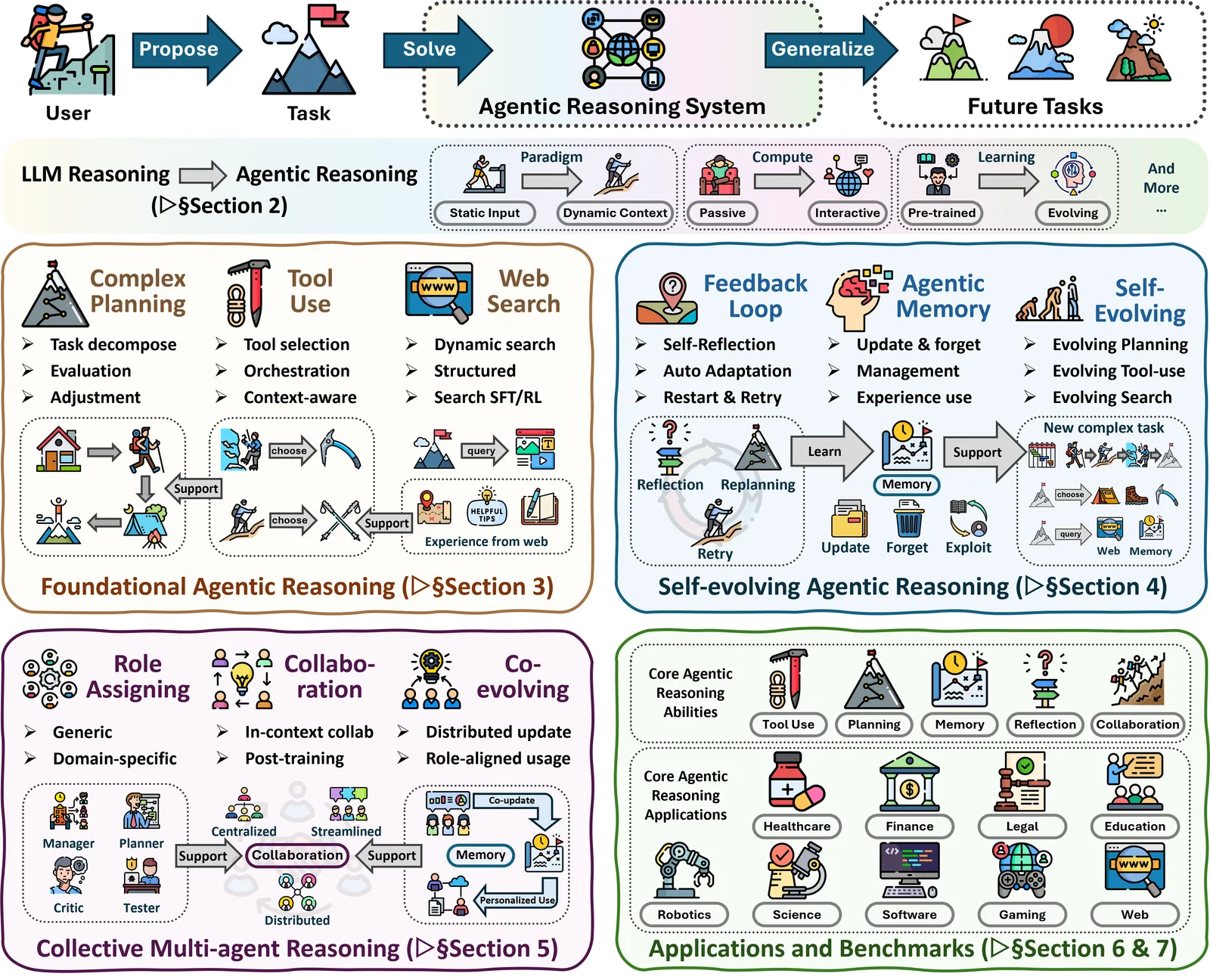
The survey organises the field along three layers (Figure 1):
- Foundational agentic reasoning: planning, tool use and search in stable environments.
- Self-evolving agentic reasoning: improving through feedback, memory and adaptation.
- Collective multi-agent reasoning: coordination, knowledge sharing and shared goals.
Across all three, it separates in-context reasoning (structured orchestration at test time) from post-training reasoning (RL and SFT).
Key results
The contribution is the map, plus a review of frameworks and benchmarks across real-world applications such as science, robotics, healthcare and autonomous research. These map closely onto the planning, memory and multi-agent posts in my own agentic AI phase this autumn.
Limitations
As a survey, it reflects the literature at the start of 2026.
Sources
- A Survey of Agentic Reasoning for Large Language Models: Towards Recursively Self-Improving and Collective Agents (arXiv:2601.12538) — arXiv
- Hugging Face Daily Papers, 2026-01-22 — Hugging Face
- Code repository (linked in the paper) — GitHub
This is a summary written from the linked public sources. Figures and numbers are as reported there.