Paper summary: Green-VLA: Staged Vision-Language-Action Model for Generalist Robots
Green-VLA is a five-stage vision-language-action training recipe, from a base VLM to RL policy alignment, with one embodiment-aware action interface that controls humanoids, mobile manipulators and fixed arms.
Problem
Vision-language-action (VLA) models should transfer across robot bodies and still work reliably on a specific real robot, here the Green humanoid.
Method
A five-stage curriculum: foundational VLMs (L0), multimodal grounding (L1), multi-embodiment pre-training (R0), embodiment-specific adaptation (R1), and RL policy alignment (R2). Supporting pieces:
- a data pipeline over 3,000 hours of demonstrations, with temporal alignment and quality filtering
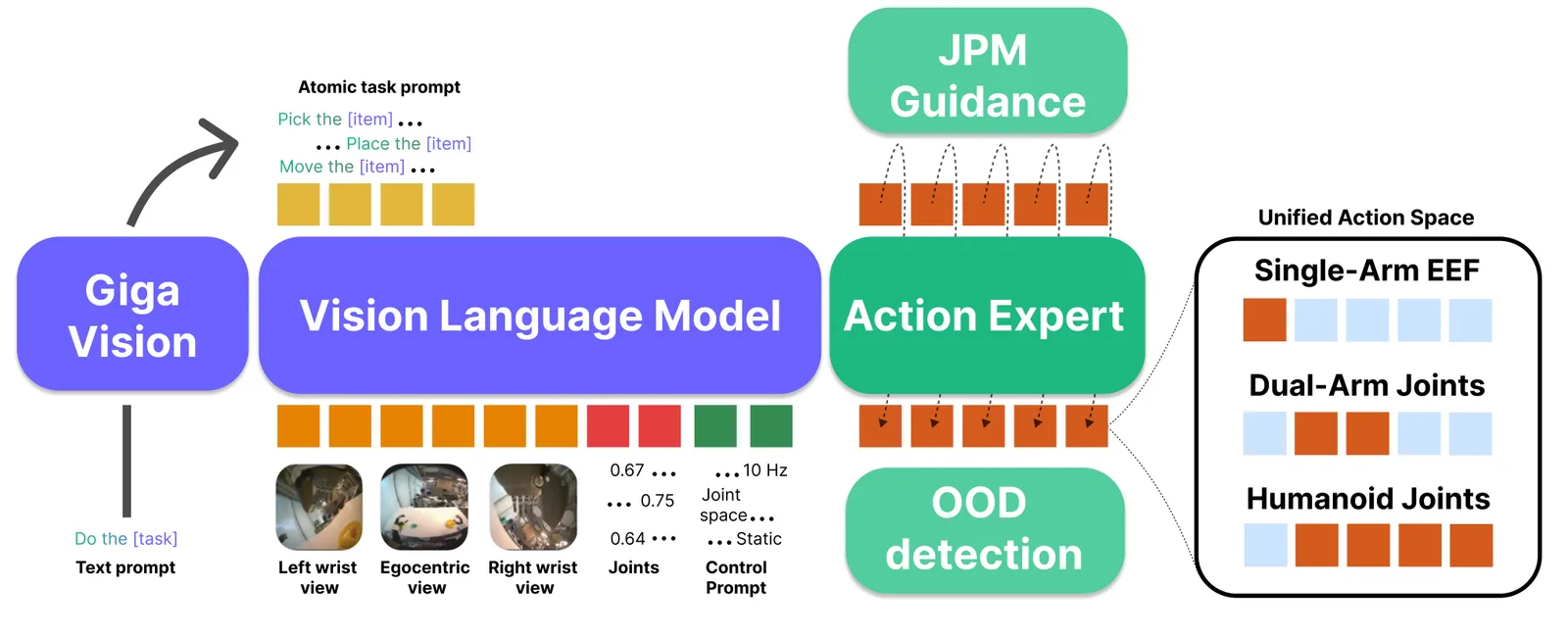
- a unified, embodiment-aware action interface, so one policy controls humanoids, mobile manipulators and fixed-base arms
- at inference: episode-progress prediction, out-of-distribution detection and joint-prediction-based guidance, for safety and precise target selection
Figure 1 shows the architecture: a VLM encodes instructions, camera views and proprioception, and feeds a flow-matching action expert.
Key results
From the abstract: on Simpler BRIDGE WidowX, CALVIN ABC-D and real robots, strong generalisation, plus gains from RL alignment in success rate, robustness and long-horizon efficiency.
Limitations
There’s no dedicated limitations section in the extracted text. The abstract reports gains qualitatively, and the numbers are in the paper’s tables.
#robotics#vision-language-action#rl
Sources
- Green-VLA: Staged Vision-Language-Action Model for Generalist Robots (arXiv:2602.00919) — arXiv
- Hugging Face Daily Papers, 2026-02-03 — Hugging Face
- Green-VLA: Staged Vision-Language-Action Model for Generalist Robots (arXiv HTML full text) — arXiv
- Code repository (linked in the paper) — GitHub
This is a summary written from the linked public sources. Figures and numbers are as reported there.