Paper summary: OPUS: Towards Efficient and Principled Data Selection in Large Language Model Pre-training in Every Iteration
OPUS picks pre-training data at every iteration by projecting each candidate's optimizer-shaped update onto a target direction, at 4.7% extra compute; GPT-2 runs on 30B selected tokens beat full 200B-token training.
Problem
The authors call it the Data Wall: high-quality public text is running out, so pre-training must use better tokens rather than more. Existing selection methods are static heuristic filters (ignoring training dynamics) or dynamic but optimizer-agnostic gradient criteria.
Method
OPUS scores each candidate by projecting its effective update, as shaped by a modern optimizer, onto a target direction from a stable, in-distribution proxy. For scale, it uses a Ghost technique with CountSketch, and Boltzmann sampling for diversity. The overhead is only 4.7% extra compute.
Key results
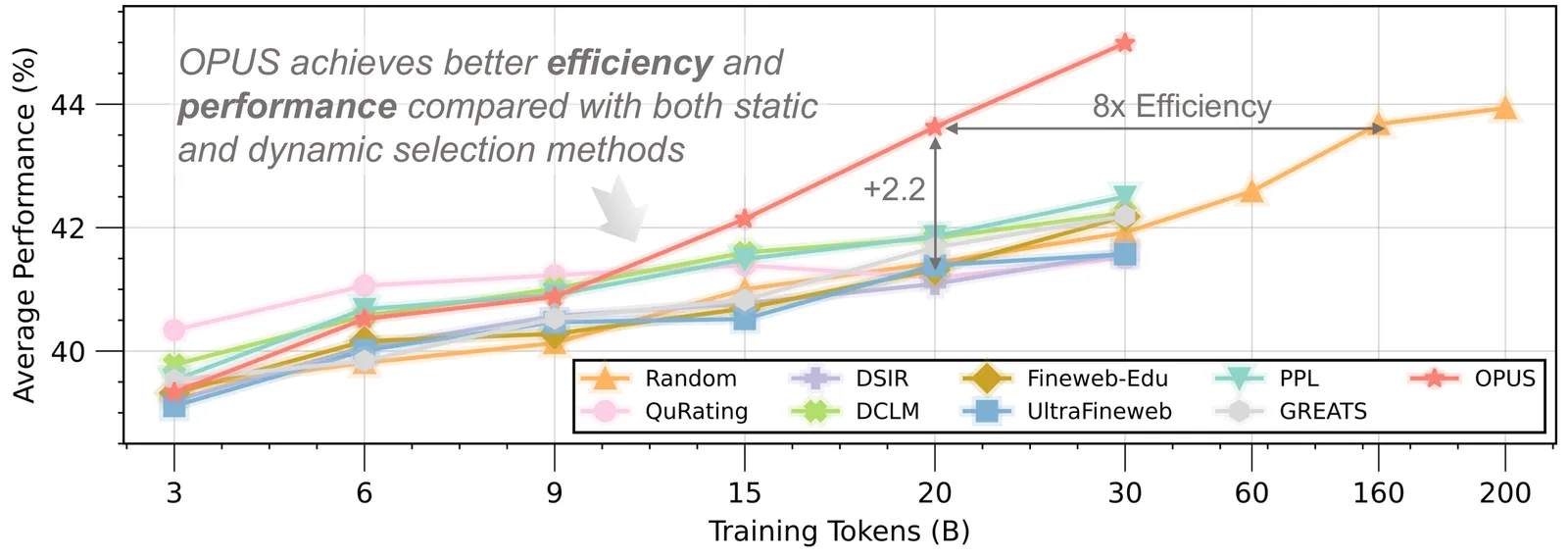
From the abstract and Figure 1:
- GPT-2 Large/XL on FineWeb and FineWeb-Edu with 30B selected tokens outperforms industrial baselines and even full 200B-token training
- combined with static filters, it improves efficiency further, even with lower-quality data
- continued pre-training of Qwen3-8B-Base on SciencePedia: 0.5B tokens beat full training on 3B
- on GPT-XL/FineWeb, an average of 2.2% higher accuracy than random selection across 10 benchmarks
Limitations
There’s no dedicated limitations section in the extracted text. The pre-training experiments are at GPT-2 scale.
Sources
- OPUS: Towards Efficient and Principled Data Selection in Large Language Model Pre-training in Every Iteration (arXiv:2602.05400) — arXiv
- Hugging Face Daily Papers, 2026-02-11 — Hugging Face
- OPUS: Towards Efficient and Principled Data Selection in Large Language Model Pre-training in Every Iteration (arXiv HTML full text) — arXiv
This is a summary written from the linked public sources. Figures and numbers are as reported there.