Paper summary: GLM-5: from Vibe Coding to Agentic Engineering
GLM-5 targets "agentic engineering" beyond vibe coding, using DSA attention to cut long-context cost and an asynchronous RL infrastructure plus new agent RL algorithms for long-horizon tasks.
Problem
Following GLM-4.5 (summarised here in Aug 2025), the goal moves from “vibe coding”, meaning casual AI-assisted coding, to agentic engineering: models that carry out long, end-to-end software tasks.
Method
- DSA (DeepSeek Sparse Attention, used during continued pre-training per the paper) reduces training and inference cost while keeping long-context fidelity.
- A new asynchronous RL infrastructure decouples generation from training, for much more efficient post-training.
- New asynchronous agent RL algorithms help the model learn from complex, long-horizon interactions.
Key results
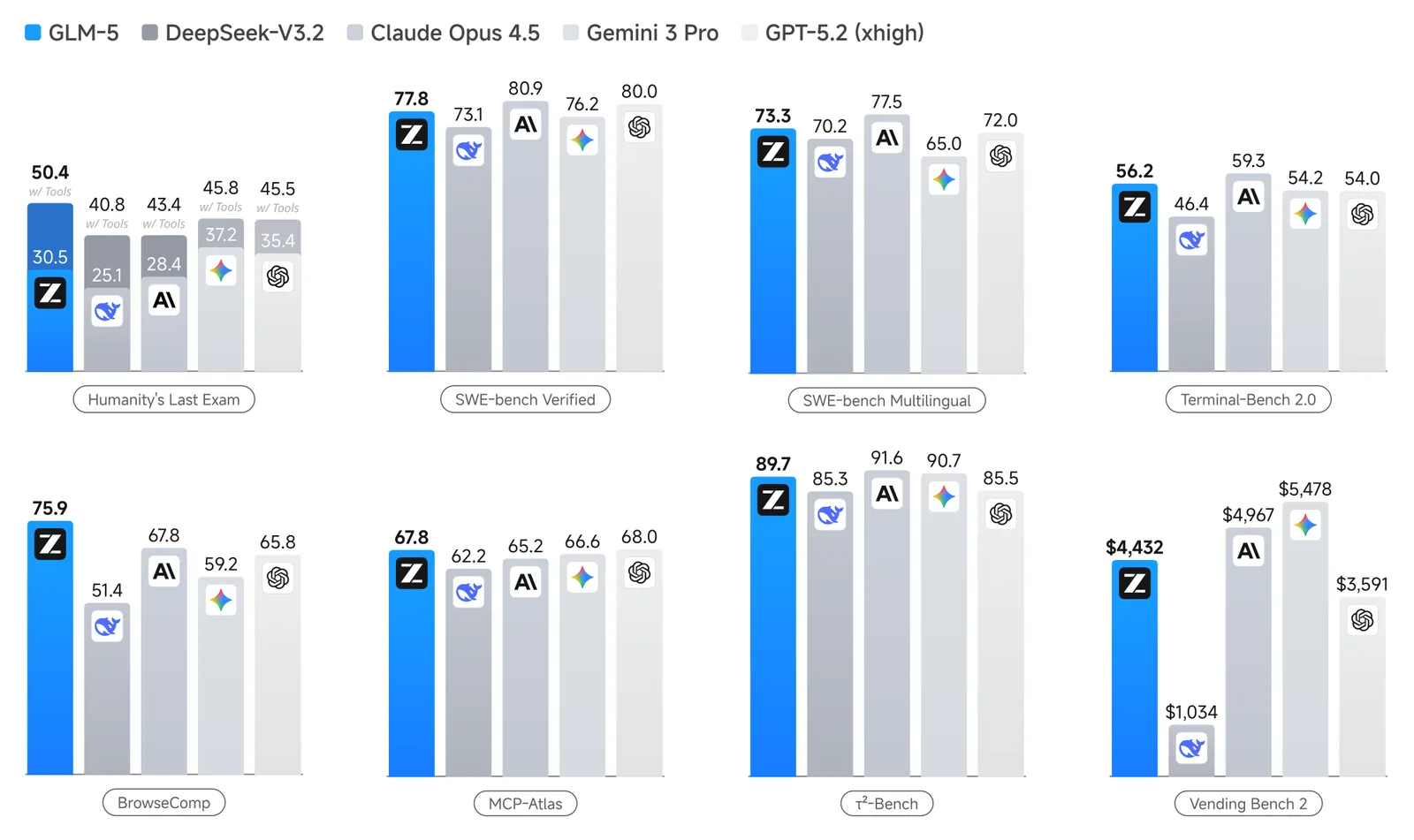
From the abstract: state-of-the-art performance on major open benchmarks, and “unprecedented” capability on real-world, end-to-end software engineering. Figure 1 compares GLM-5 with DeepSeek-V3.2, Claude Opus 4.5, Gemini 3 Pro and GPT-5.2 on eight agentic, reasoning and coding benchmarks, including Humanity’s Last Exam and SWE-bench Verified.
Limitations
There’s no dedicated limitations section in the extracted text. Comparisons are the developers’ own.
Sources
- GLM-5: from Vibe Coding to Agentic Engineering (arXiv:2602.15763) — arXiv
- Hugging Face Daily Papers, 2026-02-18 — Hugging Face
- GLM-5: from Vibe Coding to Agentic Engineering (arXiv HTML full text) — arXiv
- Code repository (linked in the paper) — GitHub
This is a summary written from the linked public sources. Figures and numbers are as reported there.