Paper summary: Recursive Multi-Agent Systems
RecursiveMAS treats a whole multi-agent system as one recursive computation in latent space, linking agents with a light RecursiveLink module and training them jointly; it reports +8.3% accuracy and 1.2–2.4× faster inference.
Problem
Looped and recursive models (Ouro, recurrent depth, TRM on this blog) scale reasoning by repeating computation in latent space. Can agent collaboration scale the same way?
Method
RecursiveMAS treats the entire multi-agent system as one latent-space recursive computation:
- a lightweight RecursiveLink module connects heterogeneous agents in a loop, so they generate latent thoughts and transfer latent states across agents instead of text
- an inner–outer loop learning algorithm co-optimises the whole system, with shared gradient-based credit assignment across recursion rounds
- theoretical analysis argues it’s more efficient than text-based multi-agent systems and keeps gradients stable
Key results
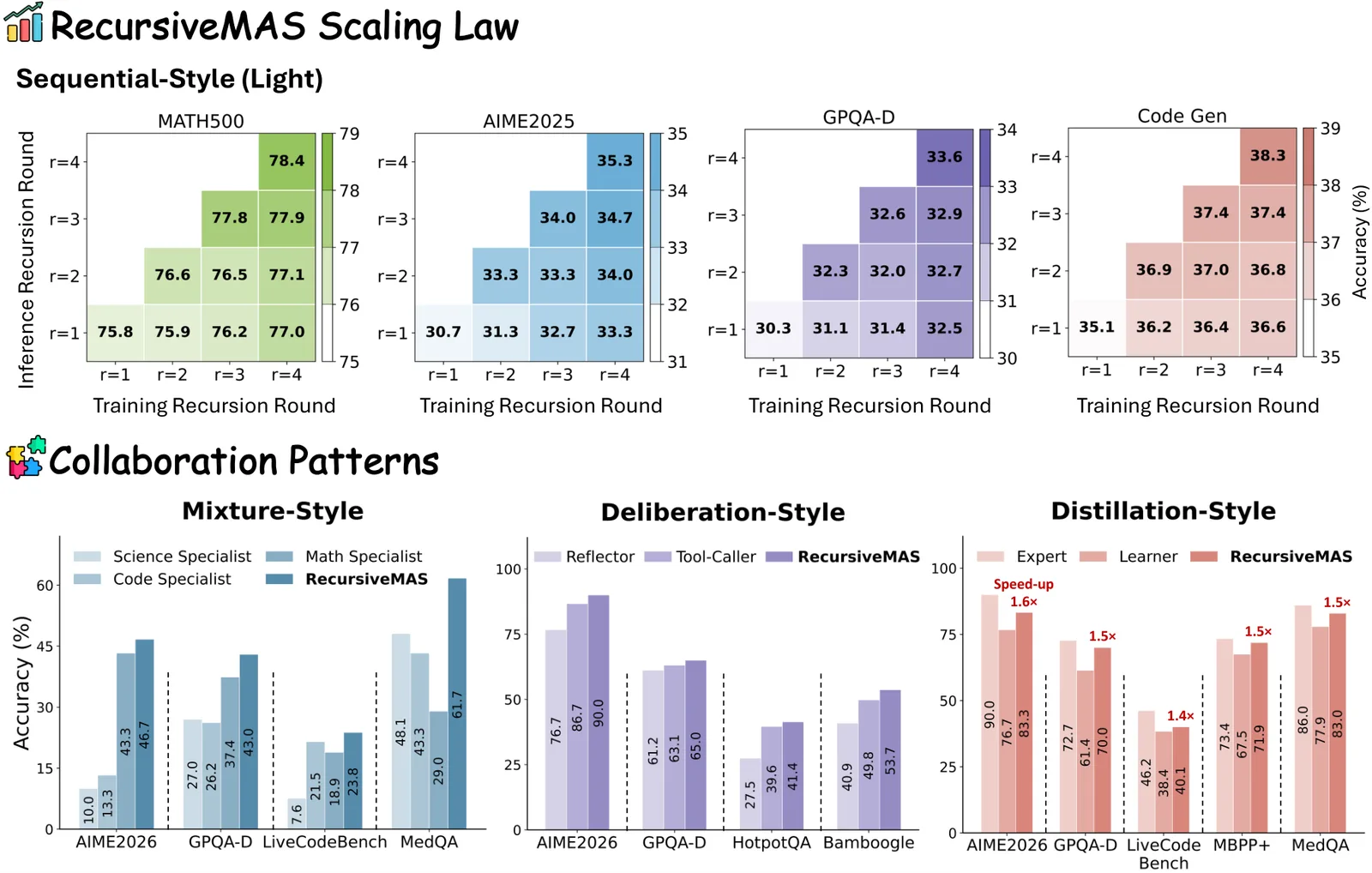
From the abstract: across 4 collaboration patterns and 9 benchmarks (maths, science, medicine, search, code), an average +8.3% accuracy with 1.2×–2.4× end-to-end inference speed-up over advanced single-agent, multi-agent and recursive baselines. Figure 1 shows a clean scaling trend as recursion deepens for sub-1.5B agents.
Limitations
There’s no dedicated limitations section in the extracted text. Latent communication is harder for people to inspect than text messages between agents.
Sources
- Recursive Multi-Agent Systems (arXiv:2604.25917) — arXiv
- Hugging Face Daily Papers, 2026-04-29 — Hugging Face
- Recursive Multi-Agent Systems (arXiv HTML full text) — arXiv
This is a summary written from the linked public sources. Figures and numbers are as reported there.