Paper summary: Code as Agent Harness
A survey that treats code as the infrastructure of agents, not just their output: the interface agents act through, the mechanism for planning, memory and verification, and the shared artefact that coordinates multiple agents.
Problem
LLMs got good at writing code. In agent systems, code now does more: it’s how agents reason, act, model their environment and verify results by running them. The authors call this setup an agent harness.
Method
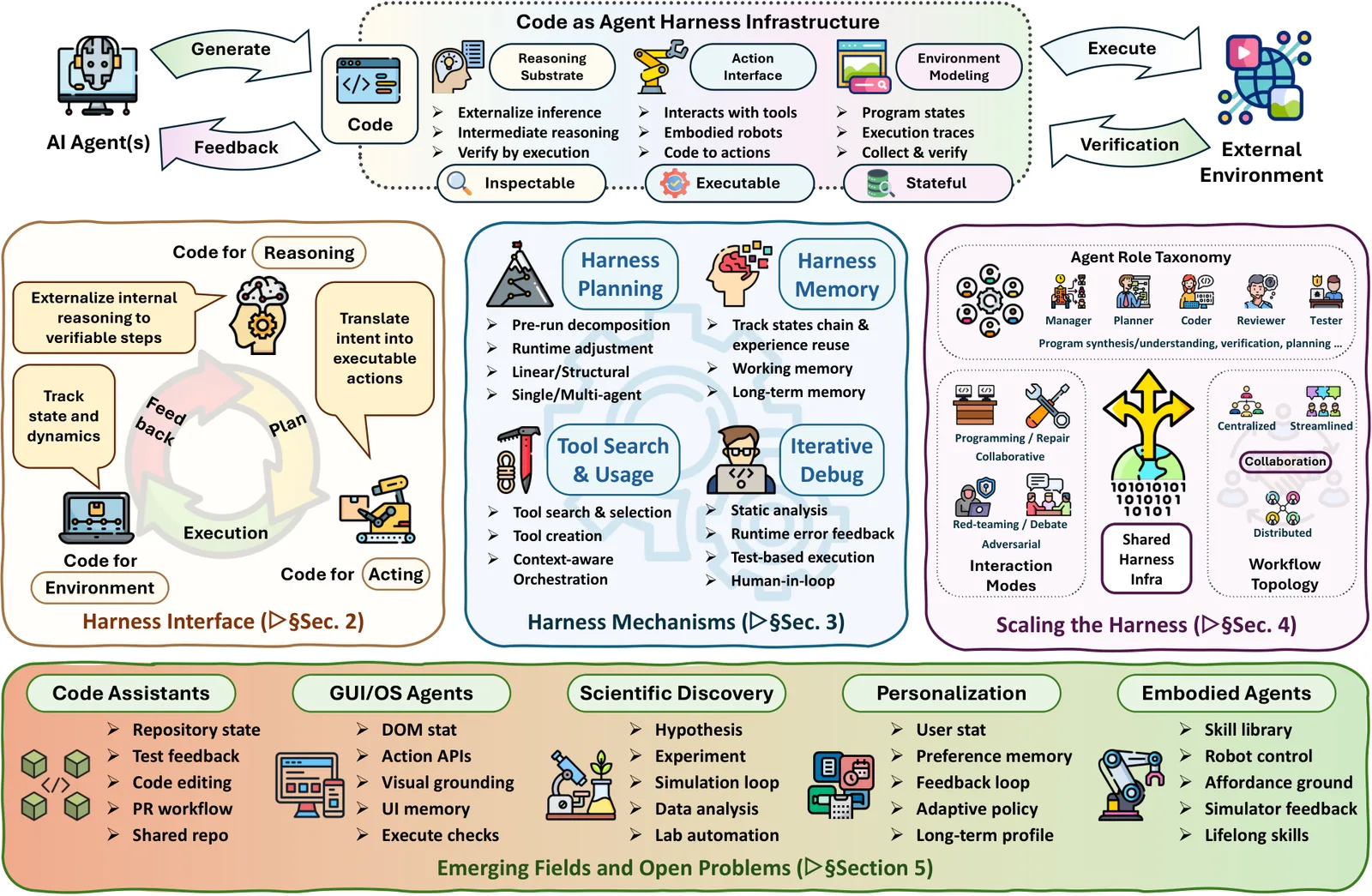
The survey proposes “code as agent harness” and organises work in three layers (Figure 1):
- Harness interface: code connecting agents to reasoning, actions and environment models.
- Harness mechanisms: planning, memory and tool use for long tasks, plus feedback-driven control that makes the harness reliable.
- Scaling: from one agent to many, where shared code artefacts support coordination, review and verification.
Key results
The survey covers applications from coding assistants and GUI/OS automation to embodied agents, science, personalisation, DevOps and enterprise workflows, and outlines open challenges, including evaluation that goes beyond final-answer checks.
Limitations
As a survey, it reflects the field in spring 2026.
Sources
- Code as Agent Harness (arXiv:2605.18747) — arXiv
- Hugging Face Daily Papers, 2026-05-19 — Hugging Face
- Code repository (linked in the paper) — GitHub
This is a summary written from the linked public sources. Figures and numbers are as reported there.