Generative AI · Stable Diffusion
Latent diffusion runs the diffusion process in a compressed latent space from a VAE; encoding and decoding a real photo with the Stable Diffusion VAE to see the 48× compression the whole model relies on.
Pixel-space diffusion at 512×512 is very expensive. Latent diffusion (Rombach et al., 2021), the basis of Stable Diffusion, splits the job in two:
- A VAE compresses an image into a small latent (512×512×3 → 4×64×64) and decodes latents back to pixels.
- The diffusion U-Net works only on latents, conditioned on text through cross-attention to text-encoder embeddings.
- At generation time: start from latent noise, denoise for N steps (with classifier-free guidance, next posts), then decode once with the VAE.
A full text-to-image run is too slow for my CPU snippets, but the VAE half isn’t. I ran the real Stable Diffusion VAE (stabilityai/sd-vae-ft-mse) on the public-domain NASA astronaut photo from scikit-image, measured the compression, and checked how much detail survives the round trip.
import os, numpy as np, torch
import matplotlib.pyplot as plt
from diffusers import AutoencoderKL
from skimage import data
torch.set_num_threads(4)

vae = AutoencoderKL.from_pretrained("stabilityai/sd-vae-ft-mse").eval()
img = torch.tensor(data.astronaut()[:, :, :3], dtype=torch.float32).permute(2, 0, 1)[None] / 127.5 - 1   # 512x512, [-1, 1]
with torch.no_grad():
    latent = vae.encode(img).latent_dist.mean
    recon = vae.decode(latent).sample.clamp(-1, 1)

print("image :", tuple(img.shape), f"= {img.numel():,} numbers")
print("latent:", tuple(latent.shape), f"= {latent.numel():,} numbers  ->  {img.numel() / latent.numel():.0f}x smaller")
print("scaling factor used by SD for latents:", vae.config.scaling_factor)
mse = ((recon - img) ** 2).mean().item()
print(f"round-trip PSNR: {10 * np.log10(4 / mse):.1f} dB")

to_np = lambda t: ((t[0].permute(1, 2, 0) + 1) / 2).clamp(0, 1).numpy()
fig, axs = plt.subplots(1, 3, figsize=(11, 3.8), dpi=140)
axs[0].imshow(to_np(img)); axs[0].set_title("original 512x512")
axs[1].imshow(latent[0, :3].permute(1, 2, 0).numpy() / 8 + 0.5); axs[1].set_title("latent 64x64 (3 of 4 channels)")
axs[2].imshow(to_np(recon)); axs[2].set_title("decoded from latent")
for a in axs: a.axis("off")
fig.tight_layout(); fig.savefig(os.environ["SNIPPET_FIG"])
Output:
image : (1, 3, 512, 512) = 786,432 numbers
latent: (1, 4, 64, 64) = 16,384 numbers  ->  48x smaller
scaling factor used by SD for latents: 0.18215
round-trip PSNR: 27.7 dB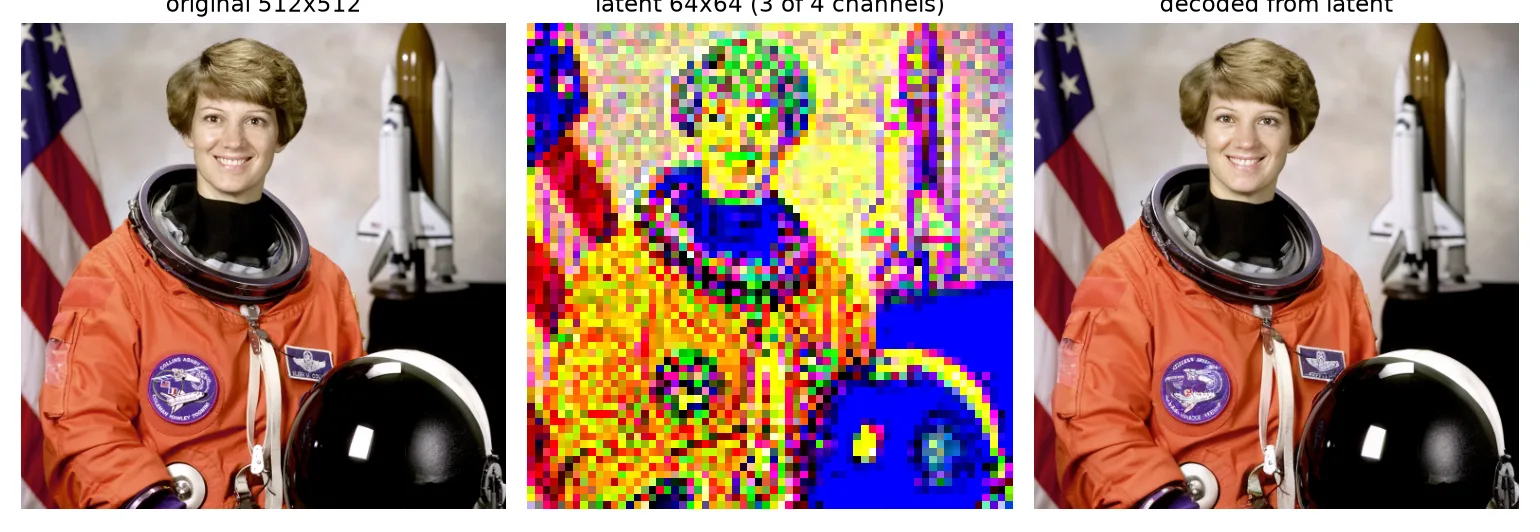
The astronaut photo (Eileen Collins) is a NASA image in the public domain, bundled with scikit-image.
#generative-ai#diffusion#stable-diffusion