Paper summary: VGI-Bench: Probing Visual Intelligence in Video Generation Models
VGI-Bench tests visual reasoning in video generation models with 27 tasks and 810 instances that require a valid process, not just a plausible final frame; the best model, Seedance 2.0, scores 51.0%.
Problem
Some work suggests video generators can reason visually through the frames they generate (“Thinking with Video” is summarised here in Nov 2025). Evaluating this reliably is hard: inputs must suit the models, solutions must show a valid process, and difficulty must be challenging but partly feasible.
Method
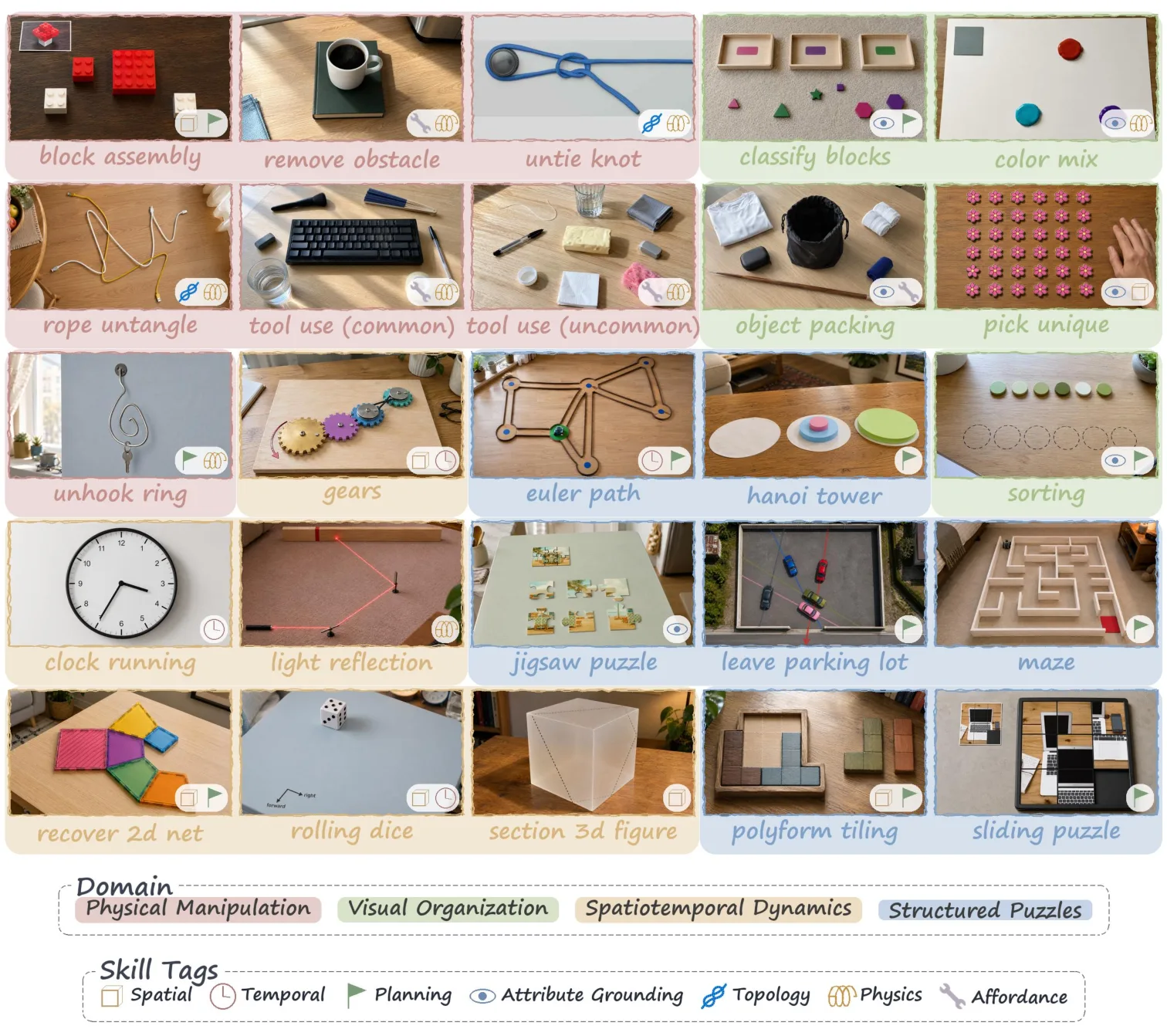
VGI-bench: 27 tasks and 810 instances, organised by a two-level taxonomy of task domains and skill tags (Figure 1). Beyond scores, the authors analyse failure modes, sensitivity to input conditions, how far synthetic fine-tuning transfers, and the denoising process itself.
Key results
From the abstract:
- current systems solve some visually grounded reasoning tasks but are far from reliable
- the strongest model, Seedance 2.0 (summarised here in April 2026), achieves only 51.0%
- self-correction is limited: later denoising steps mainly refine early hypotheses rather than fix reasoning errors
Limitations
From the paper:
- tasks fit current clip lengths (about 5–10 s), so long multi-step procedures are out of scope
- image-to-video only, at a fixed 16:9 ratio
- English-only prompts and rubrics
- the suite is representative, not exhaustive
Sources
- VGI-Bench: Probing Visual Intelligence in Video Generation Models (arXiv:2608.19583) — arXiv
- Hugging Face Daily Papers, 2026-08-27 — Hugging Face
- VGI-Bench: Probing Visual Intelligence in Video Generation Models (arXiv HTML full text) — arXiv
- Code repository (linked in the paper) — GitHub
This is a summary written from the linked public sources. Figures and numbers are as reported there.