Paper summary: Scaling Automatic Research Agents via World Models
RL for automatic-research agents is bottlenecked by slow, sandboxed experiment execution; World Model RL replaces execution with a learned world model plus debiasing and denoising, training 3–4× faster.
Problem
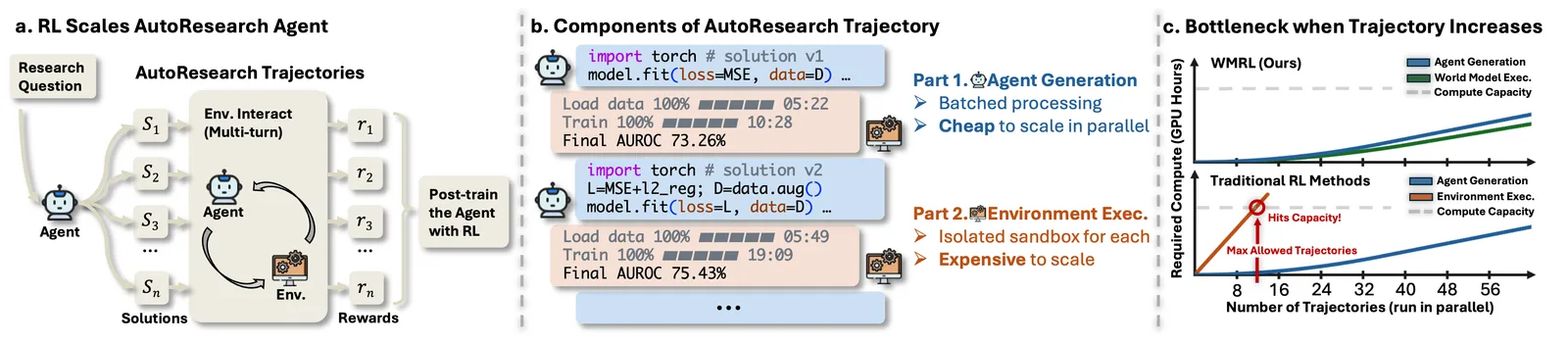
AutoResearch agents implement solutions and learn from execution results, and RL post-training is central to their gains. But the two parts of each trajectory scale differently (Figure 1). Generation shares compute through batching, while execution occupies its own sandbox and real machine time. As trajectories grow, execution dominates training cost.
Method
World Model RL (WMRL) replaces environment execution with a world model that predicts outcomes, a close relative of the language world models summarised here in June 2026. Because those predicted rewards are biased and noisy, WMRL adds:
- Online Debiasing, to offset bias
- Inverse-Variance Denoising, to suppress noise
The authors prove that both mitigations strictly improve the convergence guarantee.
Key results
From the abstract: 3–4× faster training across tasks and agent scales, while beating standard RL baselines. The post-trained 4B and 9B agents outperform much larger models, per the authors.
Limitations
There’s no dedicated limitations section in the extracted text. The approach depends on how well the world model approximates real execution, which is the problem the two mitigations target.
Sources
- Scaling Automatic Research Agents via World Models (arXiv:2608.12564) — arXiv
- Hugging Face Daily Papers, 2026-09-10 — Hugging Face
- Scaling Automatic Research Agents via World Models (arXiv HTML full text) — arXiv
This is a summary written from the linked public sources. Figures and numbers are as reported there.