Generative AI · GANs
A generator and a discriminator trained against each other; the minimax game written out, a small GAN learning a 2-D ring of Gaussians, and the mode-collapse failure it can fall into.
A GAN (Goodfellow et al., 2014) trains two networks against each other:
- the generator G(z) turns random noise into fake samples
- the discriminator D(x) outputs the probability that x is real
In practice G is trained with the “non-saturating” loss (maximise log D(G(z))), which the original paper recommends because it gives stronger gradients early on.
GANs are famous for unstable training and mode collapse, where the generator produces only part of the data’s variety. My DCGAN reproduction repo from March swaps in LSGAN loss and spectral normalisation for exactly this reason.
The classic toy problem: 8 Gaussians arranged in a ring. A good generator should hit all 8.
import os, math, torch, torch.nn as nn
import matplotlib.pyplot as plt
torch.manual_seed(0); torch.set_num_threads(4)

centres = torch.tensor([[math.cos(2 * math.pi * k / 8), math.sin(2 * math.pi * k / 8)] for k in range(8)]) * 2
def real(n): return centres[torch.randint(0, 8, (n,))] + 0.05 * torch.randn(n, 2)

G = nn.Sequential(nn.Linear(2, 128), nn.ReLU(), nn.Linear(128, 128), nn.ReLU(), nn.Linear(128, 2))
D = nn.Sequential(nn.Linear(2, 128), nn.LeakyReLU(0.2), nn.Linear(128, 128), nn.LeakyReLU(0.2), nn.Linear(128, 1))
optG, optD = torch.optim.Adam(G.parameters(), 1e-3, betas=(0.5, 0.999)), torch.optim.Adam(D.parameters(), 1e-3, betas=(0.5, 0.999))
bce = nn.BCEWithLogitsLoss()

def modes_covered(n=2000):
    with torch.no_grad():
        fake = G(torch.randn(n, 2))
    nearest = torch.cdist(fake, centres).argmin(1)
    close = torch.cdist(fake, centres).min(1).values < 0.3
    return len(set(nearest[close].tolist())), close.float().mean().item()

snapshots = {}
for step in range(1, 3001):
    x, z = real(256), torch.randn(256, 2)
    lossD = bce(D(x), torch.ones(256, 1)) + bce(D(G(z).detach()), torch.zeros(256, 1))
    optD.zero_grad(); lossD.backward(); optD.step()
    lossG = bce(D(G(torch.randn(256, 2))), torch.ones(256, 1))      # non-saturating generator loss
    optG.zero_grad(); lossG.backward(); optG.step()
    if step in (1, 500, 3000):
        m, frac = modes_covered()
        print(f"step {step:>4}: D loss {lossD.item():.3f} | G loss {lossG.item():.3f} | modes hit {m}/8 | samples near a mode {frac:.0%}")
        with torch.no_grad(): snapshots[step] = G(torch.randn(1000, 2))

fig, axs = plt.subplots(1, 3, figsize=(11, 3.6), dpi=140)
for ax, (s, pts) in zip(axs, snapshots.items()):
    ax.scatter(*real(1000).T, s=2, c="lightgray"); ax.scatter(*pts.T, s=2, c="#e0681f")
    ax.set_title(f"step {s}"); ax.set_xlim(-3, 3); ax.set_ylim(-3, 3); ax.set_aspect("equal")
fig.suptitle("GAN samples (orange) vs real data (grey)"); fig.tight_layout(); fig.savefig(os.environ["SNIPPET_FIG"])
Output:
step    1: D loss 1.368 | G loss 0.712 | modes hit 0/8 | samples near a mode 0%
step  500: D loss 1.233 | G loss 0.847 | modes hit 8/8 | samples near a mode 68%
step 3000: D loss 1.372 | G loss 0.747 | modes hit 8/8 | samples near a mode 96%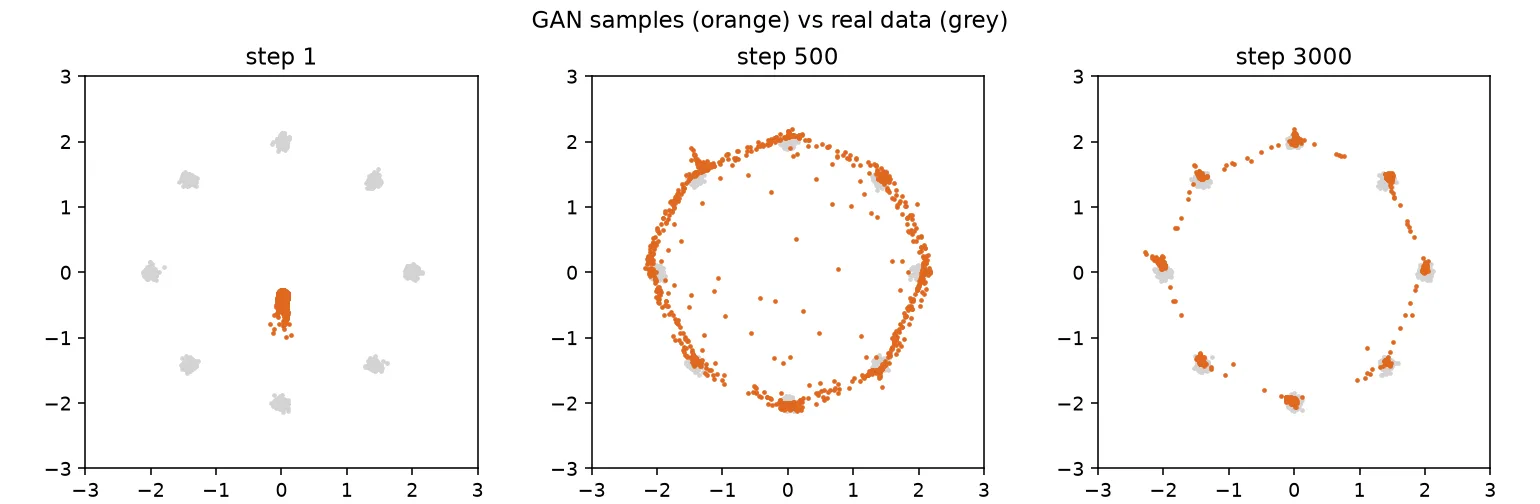
Sources
- Goodfellow et al. (2014), Generative Adversarial Networks — arXiv
- Google ML: GANs course — Google for Developers
- My repo: Modern-DCGAN-Reproducibility — GitHub